01 · C-level · Online course
Chief AI Officer from pilots to a portfolio.
Scattered pilots and “playing with ChatGPT” look like transformation — but they are not a strategy. 6 recorded classes on owning AI at C-level: strategy tied to the P&L, priorities, data, people, risks and ROI — and how to talk about it with the CEO and the board.
- 6classes, up to 45 min
- No codea role, not IT
- 1 yearof access
- Diplomaon Accredible

Mike Pritula — 21 years in HR, founder and head of strategy at Pritula Academy and author of the PapaHR AI system. #1 HR instructor on Udemy with 2M+ enrollments.
Our students work at























For leaders who own AI next to the CEO.
CEOs, founders and future CAIOs
Manage AI as a business asset, not a set of experiments — and get a clear picture of the role, its scope and its KPIs.
CIOs, CTOs, CDOs and COOs
You are already responsible for digital transformation. Learn to turn it into an AI portfolio the board understands.
Leaders who tried AI and see chaos
Fragmented initiatives and no ROI? Learn to prioritize, scale what works and shut down what does not.
Scale, pilot or shut it down?
Class 3 prioritizes AI initiatives by three questions: impact, feasibility and risk. Rate four of your initiatives — or keep our examples — and see what a CAIO would do with each.
Your portfolio
1 = low, 5 = high. A simplified version of the class 3 matrix — in the course you also check data readiness (class 4) and the planning horizon (class 2).
Get the course — $500 →
6 classes, from the role to ROI.
Frameworks, checklists and templates for the CAIO, real cases of AI transformation and a roadmap for rolling AI out across the company.
01The role of the CAIO in a company
Why AI is a management function, not an IT tool · who the CAIO is: responsibilities, influence, KPIs · CAIO vs CIO vs CTO vs CDO vs Head of Data · where the CAIO sits in the structure · models of the role in a startup, a scale-up and a corporation · mistakes of companies without an AI strategy
02AI strategy as part of business strategy
When AI is a must-have and when it is a waste of money · from business strategy to AI strategy · AI use cases along the value chain · build, buy or partner · planning horizons of 6, 12 and 36 months · presenting an AI strategy to the CEO and the board
03AI products and AI initiatives
AI initiatives vs AI products · internal vs external AI · prioritizing cases by impact, feasibility and risk · quick wins vs long-term initiatives · cases in HR, finance, marketing, sales and operations · when to shut AI down instead of scaling it
04Data, architecture and the AI landscape
Why AI does not work without data · data readiness: what the CAIO checks first · MLOps, LLMs and agents at C-level · internal models vs external platforms · vendor lock-in and technology risks · working with IT and data teams
05People, culture and AI transformation
How AI changes roles, professions and responsibilities · upskilling vs reskilling vs replacement · AI literacy for managers and employees · resistance: fears, sabotage, illusions · the CAIO’s role in AI culture · the CAIO team: who you really need to hire
06Risks, ethics, ROI and the future of the role
Legal, ethical and reputational AI risks · AI governance and principles of responsibility · how to calculate ROI from AI — and what not to calculate · CAIO KPIs: what to actually measure · typical failures of AI transformations · how the CAIO role will change in 3–5 years
One course — or the whole academy.
This course
All 6 classes, frameworks and templates, homework reviewed by Mike and a diploma. 1 year of access.
Get the course →Annual subscription
175+ academy courses, this one included — 155+ of them in English. New courses every week. For a team of up to 10 — $2,500/year.
Get the subscription →From payment to diploma.
- All classes open at onceWatch the 6 recorded classes at your own pace, on a computer or a phone. Access is for 1 year.
- Homework checked by MikeEach class has a practical task: you apply the frameworks to your own company, and Mike Pritula reviews it personally.
- Tools for workFrameworks, checklists and templates for the CAIO, an AI readiness assessment and a company-wide AI roadmap.
- DiplomaComplete the assignments and get an Accredible diploma with a unique code.
Learn from your phone
The course fits in your pocket.
- Same login as on your computerVideo, slides and files of every class — in the app for iPhone and Android.
- Progress is sharedStart a class at your desk, finish it on the way home.
- Homework from the phoneOpen the task, write the answer, attach a file and send it to Mike.
Apply it at work
See who grows with AI.
PapaHR is the HR system built by Mike Pritula with the academy’s methods inside. Its Talent and development screen shows who grows, who may leave, team skills and development plans — the upskill-or-reskill decisions from class 5 of this course.
Try PapaHR free →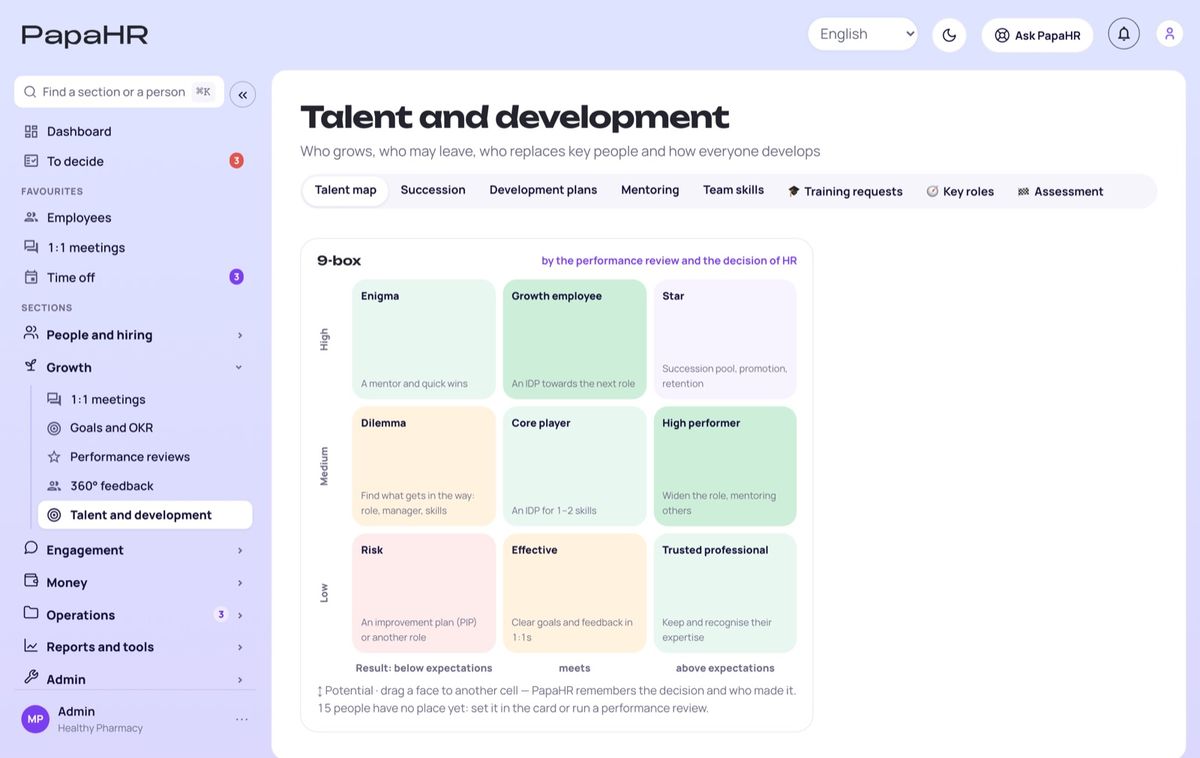
- Freeup to 25 employees with this course
- 30+modules, from the job opening to the exit interview
- 18ready-made surveys
- 5languages, English included
- Telegram · Slack · Teamsplus apps for iPhone and Android
A diploma that shows on LinkedIn.
After every course you receive a named diploma on Accredible — the same platform that issues certificates for Google, Udacity and Rosetta Stone. You can add it to your LinkedIn profile in one click.
- ✓ A unique code on every diploma — impossible to forge
- ✓ The QR code leads to an online version an employer can verify
- ✓ Adds to your LinkedIn profile in one click
- ✓ Available in English

Taught by Udemy’s #1 HR instructor.
The academy is built on 21 years of Mike Pritula’s own HR practice.
- #1 HR instructor on Udemy — 2M+ enrollments
- Author of 200+ HR books on Amazon
- Creator of PapaHR, an HR system for companies — free for up to 25 employees with this course
- 21 years in HR: Wargaming, Preply, iDeals, Starlightmedia, Alfa-Bank, PeopleForce
- Certifications PHRi, SHRM-CP, HCI sHRBP; HRCI representative in Eastern Europe
- Two YouTube Silver Play Buttons
What graduates of related courses say.

“I used to think like an HR person, mostly on the side of “the people.” Now I think bigger and understand the need for balance — not only for the staff, but for the business too. We applied a lot of it in the company, and there are improvements.”Svitlana TysiachnaDuring the course: Human Resources Lead ↑ Now: Chief Operating Officer, SelfStartGlobal Profile on LinkedIn →

“I now clearly understand the strategic value of AI tools for my role and the company as a whole — for example in recruitment, efficiency and talent retention. I got to test and evaluate these tools in practice.”Inna SalataHR Manager, LotusFlare Profile on LinkedIn →

“I discovered a wide range of useful tools and frameworks that directly support the responsibilities of a COO.”Svitlana KlymenkoDuring the course: CMO ↑ Now: COO, Sales Label Consulting Profile on LinkedIn →

“The introduction of AI in HR provided an excellent understanding of how AI technologies can be applied in recruiting, candidate sourcing, and new employee adaptation.”Yuliia VekhovaIT Recruiter, Underhood.dev Profile on LinkedIn →
This course has no published reviews yet. These reviews come from graduates of the academy’s COO and AI in HR courses — from the surveys they fill in when they receive their diploma.
Before you start.
Who is a Chief AI Officer (CAIO)?
A C-level executive responsible for the company’s AI strategy, prioritizing AI initiatives, ROI, risks and integrating AI into the business — rather than for the technical implementation of models.
How is a CAIO different from a CIO and a CTO?
The CIO and CTO are responsible for technology and infrastructure. The CAIO is responsible for the business value of AI: why it is needed, where to apply it, which initiatives to pursue and how to measure results.
Does a CAIO need to know how to program?
No. The CAIO is not a developer. The job is to manage AI as a business asset, not to write code or train models.
How does a CAIO measure the effect of AI?
Through financial and business metrics — cost savings, revenue growth, process speed, risk reduction and impact on the P&L — not the number of models and pilots.
Is this course in the subscription?
Yes. The annual subscription for $1,000 opens 175+ academy courses, 155+ of them already in English, this one included.
How long do I have access?
1 year from the day your account opens. All 6 classes are available right away.
Can I study on my phone?
Yes. Lessons open in the app for iPhone and Android with the same login and password as on your computer, and your progress is shared.
Will I get a diploma?
Yes. Complete the course assignments to receive a named Accredible diploma with a unique code and an online verification link you can add to LinkedIn.
More for C-level
Still not sure? Write to us.
Telegram WhatsApp info@pritula.academy Join the English-speaking HR chat on Telegram →