01 · HR in IT · On demand
Course HR in IT from hiring engineers to stock options — in the language of tech, not by the textbook.
A course for HR professionals working in a tech company or moving into one. 22 classes on demand: how tech companies work and what engineers want, recruiting and sourcing, employer brand and onboarding, salaries, bonuses, benefits and stock options, OKRs and 1:1s, learning and teamwork.
On-demand course · start with a free class “HR Management in IT Explained”
- 22classes on demand
- Tasksbased on your company
- 1 yearof access
- Diplomaon Accredible
170,000+ studentsNPS 80or the whole academy — $1,000 a year

Mike Pritula — founder of Pritula Academy and PapaHR, 21 years in HR.
Our students work at
























HR in IT — what is it?
HR in IT is people management in a tech company: hiring and sourcing engineers, onboarding, company culture, compensation, and growing people and teams. The functions are the same as in any HR role, but the context is different: startups, product and outsourcing companies, the software development life cycle (SDLC), stock options in compensation and OKRs in team goals.
An HR professional in IT doesn’t just build HR systems — they bring people-management know-how to tech leaders. To do that, you need to speak the same language as engineers: understand their roles, the company’s metrics and what employees want.
Four parts of the course
- Tech from the inside
- HR at Google, tech company trends, types of tech companies and their metrics, who engineers are Classes 1–4
- Hire
- Recruiting, sourcing, employer brand, onboarding Classes 5–8
- Retain
- Culture, motivation, salaries, bonuses, benefits, stock options Classes 9–14
- Develop
- OKRs, 1:1 and team meetings, HR automation, training for employees and managers, teamwork Classes 15–22
Every class comes with an assignment based on your own company, with feedback.
| What we cover | Where in the course | |
|---|---|---|
| Company | Startup, product and outsourcing companies; the SDLC and MAU, retention and LTV metrics | Class 3 |
| Hiring | Candidate scorecard, competency-based interviews, counteroffers; X-ray search and sourcing hypotheses | Classes 5–6 |
| Compensation | Salary ranges and reviews, bonuses, benefits — and stock options: vesting, cliff, strike price, phantom stock | Classes 11–14 |
| Goals | OKRs: how they differ from MBO, the first rollout in a company, the link to performance reviews | Class 15 |
Who the course is for
HR pros who just joined a tech company
How tech companies work and what engineers want — so you lay the right foundation from the first months and speak the same language as your team.
HR pros with 1–3 years in tech
Best practices of tech companies in hiring, compensation and development — plus ready-made templates you can roll out at your company.
HR pros with 3+ years in tech
Structure what you know, review recent research and apply it to your company — with assignments reviewed by the course author.
IT recruiter moving into HR
From hiring to onboarding, motivation, pay, stock options and team development — the full employee life cycle.
After class 5
Your hiring funnel — on one screen.
In class 5 you work through the ideal recruiting process, the candidate scorecard and the offer. In PapaHR, the Hiring module shows a job opening with candidates by stage — from new to offer — and a candidate scorecard. Hiring is part of the Pro plan: with the academy’s annual subscription it is included for up to 50 employees.
Try PapaHR for free →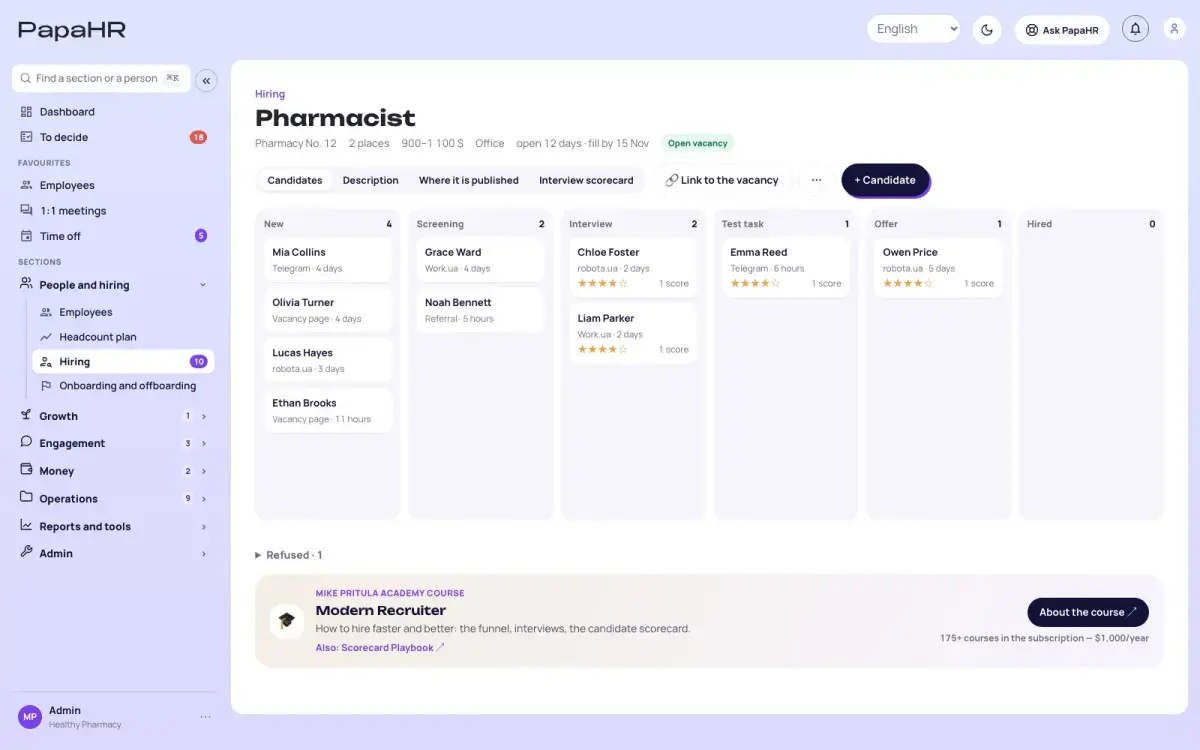
- Freefor up to 25 employees; Hiring is in Pro
- 30+modules — from job opening to exit interview
- 18ready-made surveys
- 5interface languages
- Telegram · Slack · Teamsand works on your phone
How much of a raise for a developer?
The merit matrix from class 11: the raise depends on the employee’s rating and on where their salary sits in the range. Enter the range and the salary, then pick a rating.
| Rating ↓ · Salary vs. range midpoint → | 80% or less | 80–100% | 100–120% | over 120% |
|---|
Salary below the range is “green-circled”: raises come faster. Above the range is “red-circled”: base pay is frozen and performance is rewarded with a lump sum. Class 11 also covers compa-ratio and job grading.
Buy the course — $480 →Watch a class before you pay.
A class from the course in English, 45 minutes: what HR management in tech is, the core responsibilities and decisions, tools and metrics, common mistakes and practical examples.
You can discuss the course in the academy’s Telegram chat for English-speaking students (join by request).
Join the chat →
22 classes: from hiring to teamwork.
First, how tech companies work and what engineers want. Then the full employee life cycle: hiring, onboarding, culture, compensation, goals, meetings, learning and teams. Every class comes with an assignment that gets reviewed.
01What HR in tech looks like: the Google example
- How Google sources, assesses and selects people
- Onboarding new hires (Nooglers)
- Performance and OKRs
- Company culture, the Googlegeist survey and the 20% rule
- People analytics: PiLab at Google
- Assignment: analyze Google’s HR practices and describe 5 ideas your company can adopt
02HR trends in tech companies: from AI to people-centric HR
- What is happening in HR in the tech industry
- The most innovative companies and their unusual practices
- How tech companies manage their people
- What tech companies expect from HR
- Assignment: choose 5 tech company practices to roll out at your company and describe the value they will bring
03Types and structures of tech companies: startup, product, outsourcing
- The main types of tech companies
- Org structures of tech companies
- The SDLC and how it shapes the work
- Tech company metrics: MAU, conversion, retention, LTV
- Company cultures in tech
- Assignment: describe your company’s structure, development process and metrics — or its business model (your choice)
04Who engineers are: roles and what they want
- A profile of tech employees and how they differ from others
- Developer surveys by Stack Overflow and WeAreDevelopers (2023)
- What motivates tech employees
- Assignment: describe a typical employee of your company — goals, interests, side projects, lifestyle — as a profile of a real person
05Recruiting
- The ideal recruiting process and its stages
- Candidate scorecard and sourcing strategy
- Competency-based interviews and reference checks
- The offer and handling counteroffers
- 20+ candidate sourcing channels
06Sourcing candidates
- X-ray search and advanced search strings
- Iterative search and Google CSE
- Sourcing hypotheses
07Employer brand
- How the EVP differs from the employer brand
- Brand audit and an EVP survey for employees
- The value proposition and communication strategy
- ChatGPT for outreach messages, a content plan and brand metrics
08Onboarding
- Preboarding, induction, onboarding, reboarding
- The business case for onboarding and a new-hire handbook
- An onboarding checklist and the ideal first day
- Mentoring, new-hire surveys, a Random Coffee bot
09Company culture
- The 3 core elements of culture
- How to describe culture and build it into daily work
- Desired and undesired behavior
- Rules for changing culture
10Employee motivation
- Motivation 3.0: why salary and bonuses alone don’t motivate
- Engagement: the Gallup Q12 survey and eNPS
- Happiness management and employee experience
- Assignment: run one of the employee surveys at your company
11Salary management
- Job evaluation and salary ranges
- The merit matrix and compa-ratio
- Range compression, green-circle and red-circle pay
- A lump sum instead of a raise
- Assignment: build a job grading structure
12Bonus system
- Target bonus for a position
- Daily, monthly and annual bonuses, the link to performance reviews
- Sales bonuses and team bonuses
- Assignment: choose a bonus system and describe how it works with calculations: the rate, the bonus size and how an employee works out their pay
13Benefits in tech
- Cafeteria plans and flexible benefits
- The business case for benefits and assessing what employees need
- Analyzing how vacation is used
- Workplace requirements
- Assignment: design a benefits package for your company and tie it to business goals
14Stock options in tech
- Vesting, cliff, strike price
- Options for executives and employees, grants based on performance
- Legal limits and compliant implementation
- Phantom stock
- A platform for granting options
- Assignment: describe an employee stock option plan
15Performance management and OKRs
- What OKRs are and 5 differences from MBO
- The first OKR rollout in a company and wrapping up a cycle
- Requirements for key results and the link to performance reviews
161:1 meetings
- A meeting template and building rapport
- Questions for every situation, feedback and coaching
- An employee issues checklist and a meeting summary
- Free templates for tracking meetings
17Team meetings
- 5 types of team meetings
- Weekly team meetings, strategy sessions and offsites
- Agendas and meeting notes
- Company meeting rules
- Assignment: prepare a meeting agenda or run your team’s weekly meeting (your choice)
18HR and recruiting automation, ATS
- 10+ HR systems, including PeopleForce
- Recruiting and learning systems, a scorecard for choosing a system
- A simple chatbot, AI and ChatGPT for routine tasks
19Employee learning
- A training needs survey and a learning policy
- The Kirkpatrick model and the 6D model
- Individual development plans, the 9-box grid and succession planning
- The 70-20-10 rule
20Teaching managers the basics of people management
- Developing managers by leadership level
- People management tools for managers
- Development formats, books and leadership training
21Team building
- 10+ team building formats
- Surveys before and after team building, a request template
- RACI for cross-team work
- The business case for team building
- Assignment: come up with a team building idea and a planning form — or an evaluation survey for afterwards (your choice)
22Teamwork
- How a team differs from a group of people
- Tuckman’s stages of team development
- Patrick Lencioni’s five dysfunctions of a team
- Diagnosing team problems
- Assignment: take a teamwork test with your team and draw up an improvement plan; identify your team’s stage of development
After the course
Your LinkedIn — HR in a tech company.
Your Name
HR Manager · Tech company: hiring, compensation, stock options, teams
Experience
- Job gradingClass 11
- Bonus system with calculationsClass 12
- Benefits package tied to business goalsClass 13
- Employee stock option planClass 14
Licenses & certifications
Skills
- HR in IT
- Tech recruiting
- Job grading
- Stock options (ESOP)
- OKRs
- Teamwork
Each experience line is a course assignment, with the class number next to it. You do them at your own company.
What HR managers earn in Europe
$5,300a month — average across 5 countries
€56,300 a year
- Ireland$5,600
- Germany$5,600
- United Kingdom$5,400
- France$5,200
- Spain$4,500
Glassdoor, November 2026: average HR Manager base salary excluding bonuses, simple average across countries; all industries, not just tech. Converted at the ECB rate on 11/02/2026: €1 = $1.1216, £0.8358. The course does not guarantee a job or salary.
One course — or the whole academy.
This course
All 22 classes on demand, assignment reviews and a diploma. 1 year of access.
Buy the course →Annual subscription
175+ academy courses, 155+ already in English — including this one, Senior IT Recruiter and Modern Sourcer. Classes, assignment reviews and diplomas for every course.
Subscribe →For teams
A subscription to 175+ courses, 155+ already in English, for a team of up to 10 — for example, the HR team and managers of a tech company.
Buy for your team →With the Senior IT Recruiter course — $1,020. All of HR in a tech company plus in-depth tech recruiting.
Two courses — $1,020 →Three courses: + Modern Sourcer — $1,350. HR in tech, tech recruiting and finding candidates who aren’t looking.
Three courses — $1,350 →From payment to diploma.
- Classes at your own paceVideos, slides and materials for every class are in your student account, on your computer or phone. 1 year of access.
- Reviewed assignmentsEach class has an assignment based on your own company: an employee profile, job grading, a bonus system, a benefits package, a stock option plan, a team meeting agenda and more. You get feedback on every one.
- Questions in the chatYou can discuss the course and your own challenges in the academy’s Telegram chat for English-speaking students (join by request).
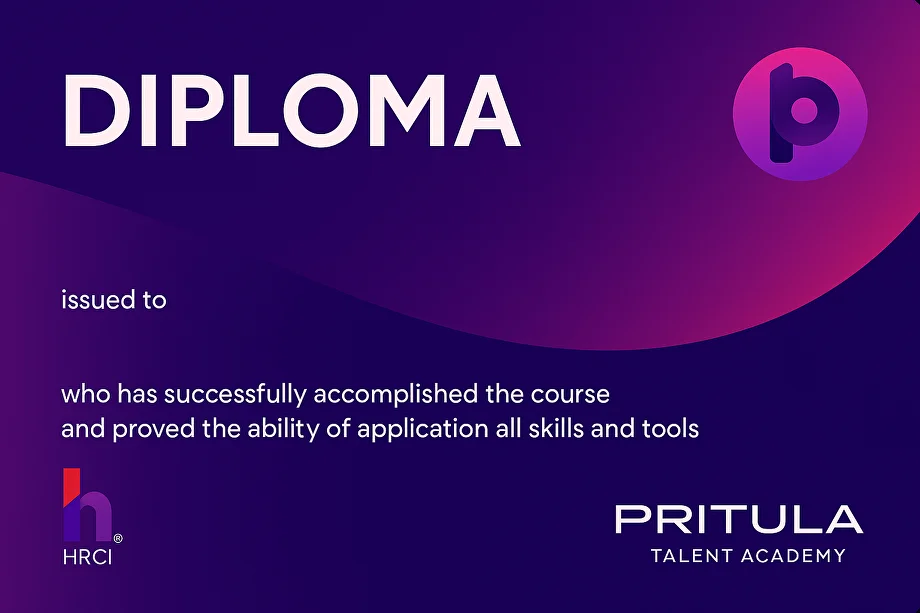
- DiplomaComplete the course assignments and get an Accredible diploma with a unique code.
Study on your phone
The course fits in your pocket.
- Same login as on your computerVideos, slides and files for every class — in the iPhone and Android app.
- Shared progressStart a class at your desk, finish it on the way home.
- Assignments from your phoneOpen the assignment, write your answer, attach a file and submit it for review.
A diploma that shows on LinkedIn.
After the course you receive a diploma in your name on Accredible — the same platform that issues certificates for Google, Udacity and Kaplan University.
- ✓ A unique code on every diploma — impossible to forge
- ✓ The QR code leads to an online version an employer can verify
- ✓ Add it to your LinkedIn profile in one click
- ✓ Available in English

Taught by Udemy’s #1 HR instructor.
The academy is built on Mike’s 21 years of HR practice.
- #1 HR instructor on Udemy — 1.9M enrollments
- PapaHR is free for up to 25 employees
- 21 years in HR: Wargaming, Preply, iDeals, Starlightmedia, Alfa-Bank, PeopleForce
- Certifications PHRi, SHRM-CP, HCI sHRBP; HRCI representative in Eastern Europe
- Two YouTube Silver Play Buttons
What graduates say.

“When I took the course, I wasn’t employed yet; I just wanted to enter the IT industry. After this course, my dream came true. I gained many insights and tools that I have already applied in my work process.”Olesea Radu-SaracinovDuring the course: HR Manager, Agile Partners ↑ Now: HR Director, Agile Partners Profile on LinkedIn →

“I especially valued the in-depth look at onboarding and adaptation in the course. I was able to rethink and improve this process at my company, which led to smoother, more effective integration of new hires.”Yana VladovaHR Manager Profile on LinkedIn →

“I liked that there are supporting materials that will genuinely come in handy later.”Maryna RomashkinaHR Generalist, Enavate Profile on LinkedIn →

“The course is extremely useful and full of practical tips and exercises that build new skills and immerse you in the world of IT.”Hanna SeredaAssociate Professor, Vasyl’ Stus Donetsk National University Profile on LinkedIn →
Reviews of the HR Management in IT course come from the surveys graduates fill in when they receive their diploma.
Frequently asked questions.
What is HR in IT?
HR in IT is people management in a tech company: hiring and sourcing engineers, onboarding, culture, compensation, and growing people and teams. The functions are the same as in any HR role, but the context is different: startups, product and outsourcing companies, the software development life cycle, stock options in compensation and OKRs in team goals.
How is HR in IT different from HR in other companies?
The tasks are the same, the tools are different. You need to understand how the company works — startup, product or outsourcing, the SDLC, MAU and retention metrics (class 3) — and what engineers want (class 4). Strong engineers are found through sourcing (class 6), and compensation includes benefits and stock options on top of base pay and bonuses (classes 13–14).
How do I get into HR in IT?
Learn how tech companies and their people work (classes 1–4), master tech recruiting and sourcing (5–6) and the full employee life cycle — from onboarding to teamwork (7–22). You work through the assignments on a real company, so by the end you have ready-to-use documents: job grading, a bonus system, a benefits package and a stock option plan.
Can I take the course without tech experience?
Yes. The course suits people who have just joined or are moving into tech, as well as HR professionals with 1–3 or 3+ years in tech. You need a basic understanding of HR; if you are starting from scratch, begin with the course HR Specialist.
How is this course different from the IT recruiter course?
Senior IT Recruiter goes deep into tech hiring. HR Management in IT covers the full employee life cycle: hiring and sourcing are 2 classes out of 22, the rest are onboarding, culture, compensation, goals, meetings, learning and teams. The two courses together are $1,020.
What are stock options and vesting?
A stock option is the right to buy company shares at a price set in advance. The right passes to the employee gradually — that’s vesting: usually 4 years in equal parts, with the first 25% unlocking only after a year of work (the cliff). Leave before the cliff and you get no options. Options and phantom stock are covered in class 14; the vesting calculator is at the top of this page.
What are OKRs?
OKRs (Objectives and Key Results) are a goal-setting method: an objective and measurable key results for it. Class 15 covers 5 differences between OKRs and MBO, the first OKR rollout in a company, requirements for key results and the link to performance reviews.
How much does an HR manager earn in Europe?
According to Glassdoor (November 2026), the average base salary of an HR Manager across 5 European countries is $5,300 a month, across all industries. We don’t give separate figures for tech companies. The course does not guarantee a job or salary.
Is the course included in the subscription?
Yes. The $1,000 annual subscription unlocks 175+ academy courses, 155+ already in English — including this one, Senior IT Recruiter and Modern Sourcer.
How long is access?
1 year from the day your account opens. All 22 classes are on demand.
Can I study on my phone?
Yes. Classes open in the iPhone and Android app: same login and password as on your computer, with shared progress.
Will I get a diploma?
Yes. Complete the course assignments and get an Accredible diploma in your name with a unique code and online verification. In English; Ukrainian or Russian on request.
Other courses for HR in tech
Still have questions? Write to us.
Telegram WhatsApp info@pritula.academy Academy student chat on Telegram →