



01 HERO · CIPD LEVEL 5 · PEOPLE MANAGEMENT

CIPD Level 5 on the first attempt.

More than 30% of first written submissions at Level 5 are referred and sent back for rework. You will enter the programme already knowing the system, the providers and the submission method — before the others work out what is coming.

  • 10 lessons · 45 minutes
  • Recorded
  • Homework reviewed
  • 1 year of access
  • Accredible diploma

180+ courses · a new course every week · 150,000+ students

A preparatory course by Pritula Academy. Not affiliated with CIPD: the Level 5 qualification is awarded only by an accredited provider.

People enter the diplomablind.

They pick a provider from an ad, open each unit as it arrives and write the first submission like a report at work. This course covers everything that happens before and during the diploma — except the programme itself, which the provider delivers.

WHAT IT IS

Preparation for the CIPD Level 5 diploma

10 lessons of 45 minutes — the whole path from “do I even need Level 5” to a personal plan for all seven units.

  • The CIPD system: levels, pathways, membership
  • Choosing a provider against 8 criteria and costing the budget
  • Written work method: how to read a brief and build an answer
  • The content of all 7 units and the usual traps
  • A personal diploma plan for 10–12 months
WHO IT IS FOR

HR professionals with 1–5 years of experience

  • Decided on Level 5 and are choosing a provider
  • Already enrolled and worried about the first submissions
  • Building a career in the UK, UAE, Saudi Arabia and Europe
  • Know operational HR but not the CIPD system

You need 6–12 months of HR experience or a university degree, plus English at reading level.

WHAT IT IS NOT

Honest boundaries

  • Not an accredited CIPD programme — the provider awards the qualification
  • We do not write submissions for you: that breaks CIPD rules
  • No pass guarantee — the course gives the method, you do the work
THE SHIFT · BEFORE AND AFTER
  • Picks a provider from the first ad or a tip in a chat Compares against 8 criteria and costs the full budget including hidden fees
  • Cannot tell the seven units apart or where to start Knows each unit, the submission order and the usual traps
  • Writes the submission like a report at work Builds the answer on “one assessment criterion — one block” and references from a template
  • Learns why work was referred only from feedback after failing Checks the draft against a checklist before submitting
Take the course for $800

Not tips inside,but a system.

The course follows the same order as your diploma: first the provider and budget decision, then the rules of written work, then the six mandatory units, and finally — a personal plan for 10–12 months.

  1. 01 Lessons 1–2

    System and decision

    How CIPD works, whether you need Level 5, which provider to pick and what the whole path costs.

  2. 02 Lesson 3

    Rules of the game

    How a brief is read, how academic text is written and what gets work referred.

  3. 03 Lessons 4–9

    Six mandatory units

    Each unit in real submission order: content, models, submission format, traps.

  4. 04 Lesson 10

    Diploma strategy

    Choosing the seventh unit, submission order, a pace without burnout and the final checklist.

THE METHOD

One criterion — one block of the answer

Work is not marked as a whole but criterion by criterion: miss one and the entire submission comes back. So the answer is assembled not as an essay but as a set of blocks — one per criterion in the brief.

  • We break the brief into criteria before the first line is written
  • Each criterion gets its own block: claim, evidence, example, conclusion
  • The verb sets the depth: explain, analyse or evaluate
  • The draft is checked against a checklist before it goes to the provider
20+ TOOLS INCLUDED
  • Provider comparison matrix
  • Full budget calculator
  • Brief-to-criteria breakdown
  • Submission structure templates
  • Referencing cheat sheet
  • Academic phrase bank
  • Templates for every unit
  • Diploma planner
  • Final pre-submission checklist

Ten lessons,unit by unit.

The first three lessons cover the decision and the rules. Lessons 4–9 walk through the six mandatory units in real submission order. The tenth pulls it all into a personal diploma plan.

  • 10 lessons
  • 45 minutes each
  • Homework with every lesson
  • 1 year of access
01

The CIPD map: three levels, two pathways, seven units

How the system people pay £2,500+ for actually works
  • Why employers in the UK, Europe and the Gulf list CIPD in job ads
  • Three levels (3, 5, 7) and the UK qualifications framework: levels 4 and 6 do not exist
  • Two pathways at levels 5 and 7 — people management and L&D — and how to pick yours
  • How Level 5 is built: 7 units, credits, roughly 30 study hours per unit
  • Qualification and membership are different things: the path from Foundation to Chartered Fellow
  • Level 3 can be skipped: the readiness criteria for going straight to Level 5
  • CIPD and SHRM: where each standard carries weight
  • Level 5 in money: £34,000–55,000 in UK roles such as HR Advisor and Talent Manager

Outcome You see the whole CIPD system and know exactly where you start.

02

Enrolment: provider, budget, a 12-month plan

How not to pay £2,800 to the wrong provider
  • The provider market: £2,290–2,800+ and what the price includes
  • Eight selection criteria: accreditation, format, tutor support, deadlines, instalments, community, guarantees, reviews
  • Self-paced, live online or blended — who each suits
  • Hidden costs: membership fee, resubmissions, access extensions
  • The diagnostic interview: what they ask and how to pass it
  • Realistic workload and the usual planning mistakes
  • Why unit 5CO01 is submitted first
  • Provider red flags and “we'll write it for you” services that lead to disqualification

Outcome A chosen provider, a costed budget and a 12-month plan.

03

Rules of the game: assessment criteria and academic writing

Why 30% of first submissions are referred and how to write so yours passes
  • Marking is binary: work is either accepted or sent back for rework
  • Anatomy of a brief: task, assessment criteria, word count, guidance
  • The “one criterion — one block of the answer” rule
  • Criterion verbs (explain, analyse, evaluate) demand different depth
  • Word count ±10%: what counts and what does not
  • Academic style versus a work report: the paragraph formula and critical writing instead of retelling
  • Referencing from a template and where to find sources: 8–12 per submission
  • CIPD rules on artificial intelligence: what is allowed and what voids your qualification
  • The four main reasons work is referred and how resubmission works
  • A real extract analysed: how an accepted answer differs from a referred one

Outcome You can decode any brief and write a structure that gets accepted.

04

5CO01 — Organisational performance and culture

The first unit: structure, strategy, culture
  • Why 5CO01 frames every other unit
  • Organisational structures and their pros and cons — an examiner favourite
  • The strategy → product → customer chain and the people function's role in it
  • PESTLE analysis of the external environment and current labour market trends
  • Culture models (Handy, Schein) and how culture links to performance
  • Change management: Lewin and Kotter — what is enough to pass
  • Employee wellbeing as a performance factor
  • What a 5CO01 submission looks like: typical criteria and traps

Outcome You are ready for the content and the submission of the first unit.

05

5CO02 — Evidence-based practice

The hardest unit: data, metrics, critical thinking
  • Four sources of evidence: research, organisational data, practitioner expertise, stakeholder views
  • Critical thinking against HR myths: how to test a claim
  • Quantitative and qualitative methods: when to use which
  • Calculating and interpreting turnover, retention and absence — with formulas
  • Presenting data for decisions: the table and chart that convince
  • Ethics of working with people data
  • Why this unit is considered the toughest: calculations inside the submission
  • Typical reasons 5CO02 work is referred

Outcome You can calculate the metrics and build an argument on data.

06

5CO03 — Professional behaviours and valuing people

The reflective unit: ethics, courage, development
  • The Profession Map: values, knowledge and behaviours at the core of the unit
  • Ethics in HR work: decision frameworks and common dilemmas
  • Professional courage: how to challenge the business with an argument
  • Inclusion as behaviour, not a slogan
  • Continuing development: the reflection cycle and keeping records
  • An honest self-assessment against the Profession Map
  • A special format: reflective writing in the first person — the only unit where “I” belongs
  • The classic mistake: retelling theory instead of reflecting on your own experience

Outcome You are ready for the reflective format and have a development plan.

07

5HR01 — Employment relationship management

Employee voice, conflict and the UK context
  • Employee voice: direct and representative mechanisms
  • Engagement: drivers and the link to performance
  • Conflict: formal and informal routes, the role of mediation
  • Disciplinary and grievance procedures: the ACAS Code framework
  • Trade unions and collective bargaining: the minimum to pass
  • UK employment law for non-UK students: what to cite
  • Misbehaviour versus conflict: the distinction the criteria test
  • Typical criteria and traps in 5HR01

Outcome You can navigate the UK specifics of employment relations.

08

5HR02 — Talent management and workforce planning

Forecast, funnel, retention
  • The workforce planning cycle: demand, supply, gaps, action plan
  • Forecasting methods — from trend analysis to scenarios
  • Labour market analysis: where to find data on skills availability
  • The hiring funnel and the role of employer brand
  • Talent development: succession and career paths as a retention tool
  • Retention: why people leave and turnover analysis by segment
  • Forms of employment and contingent workers: what the criteria test
  • Typical criteria and traps in 5HR02

Outcome You are ready for the content and submission on talent management.

09

5HR03 — Reward for performance and contribution

Money: fairness inside, competitiveness outside
  • Total reward: base pay, benefits, incentives and the non-financial part
  • Internal equity: job evaluation and building grades
  • External competitiveness: market benchmarking and working with salary surveys
  • Equal pay and the gender pay gap: the UK context and reporting duties
  • Performance-related reward: when it works and when it harms
  • The role of line managers and the risk of subjectivity
  • The legal minimum: national minimum wage and mandatory elements
  • Typical criteria and traps in 5HR03

Outcome You are ready for the content and submission on reward.

10

Diploma strategy: the seventh unit, pace, plan

Everything comes together in a personal plan to pass first time
  • The optional units reviewed: employment law, diversity and inclusion, wellbeing, leadership development, international people management
  • How to choose: career goal, difficulty of the submission, availability at your provider
  • Unit order strategy: from 5CO01 towards specialism
  • A pace without burnout: 5–8 hours a week alongside your job, with slack for resubmissions
  • The final “first submission, no referral” checklist
  • Membership after the diploma and the route to Chartered Member
  • The diploma in your career: CV, LinkedIn, salary negotiations
  • Filling in your personal plan: units, deadlines, checkpoints

Outcome A personal diploma strategy and the final checklist.

Take the course for $800

Three waysto start.

One course — or a year of access to every certification programme in the academy, this one included. One payment, access for a year.

COURSE

CIPD Level 5 Preparation

$800one-off
  • 10 recorded lessons of 45 minutes
  • Homework reviewed
  • 20+ tools: provider matrix, templates, checklists
  • Accredible diploma once all homework is done
  • Academy students chat
  • 1 year of access
Take the course
Better value SUBSCRIPTION + CERTIFICATIONS

All certification programmes

$2 900per year
  • This course is included in full
  • All certification courses: HRCI, SHRM, CIPD
  • Live HR MBA sessions
  • An Accredible diploma for every course completed
  • 1 year of access
Get a year of access
TEAM

Certifications for your team

$6 000per year
  • Up to 10 people per team
  • All certification courses in the academy
  • Live HR MBA sessions
  • An Accredible diploma for every member
  • 1 year of access
Request for a team

This course is not part of the standard $1,000/year subscription — only the plans that include certifications. Compare all options: pritula.academy/plans

Behind the promise there arenumbers.

The academy has been running since 2011. A new course ships every week — so the HR people who learn here hear about changes ahead of the market instead of chasing them.

  • 150 000+ students of the academy
  • 14 years in HR education
  • 185 countries our students come from
  • 180+ courses in the catalogue, a new one every week
  • 80 NPS — the score students give us
  • Silver Play Buttons for our YouTube channels
REVIEWS

Below — what students say about the lessons, the homework reviews and the outcome.

Learn at your own pace,not someone else's.

Once you enrol, every lesson is open straight away. You watch 45 minutes whenever it suits you and submit homework at your own rhythm — alongside your job and your diploma preparation.

  1. 01

    Watch the lesson

    45 recorded minutes in your account. In the evening, or in pieces.

  2. 02

    Do the homework

    Short and practical: compare providers, break a brief into criteria, build a plan.

  3. 03

    Get feedback

    Mike reviews homework personally and writes back what to fix.

  4. 04

    Keep the tools

    Templates, checklists and spreadsheets stay in your account — you use them across the whole diploma.

  5. 05

    Get the diploma

    Once all homework is done — an Accredible diploma with a verification code and one-click LinkedIn transfer.

FREE ACCESS

See a lesson before you pay

The academy bot opens a free lesson — you see the format, the pace and the depth before you decide. It replies instantly, with no form and no sales call.

Open the free lesson

Work shows,when it is verified.

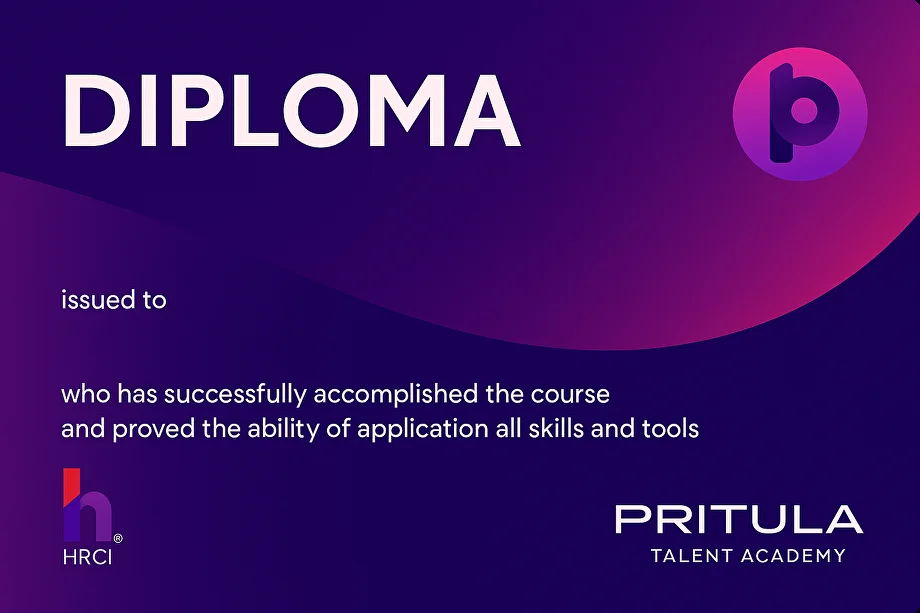
Once all homework is complete you receive the academy diploma on Accredible — the same platform that issues certificates for Google, Udacity and Kaplan University.

  • A unique code and a link an employer can verify
  • A QR code printed on the diploma
  • Added to LinkedIn in one click
  • Yours permanently, unlike course access

This is a Pritula Academy diploma confirming completion of a preparatory course. The CIPD Level 5 qualification and CIPD membership are awarded only by an accredited provider after their own programme.

Take the course for $800
Pritula Academy diploma on Accredible
Mike Pritula — founder of Pritula Academy

Behind the course there isa person.

Mike Pritula — 20 years in HR and founder of Pritula Academy. He reviews course homework himself: you get feedback from a practitioner, not an automated mark.

  • PHRi
  • SHRM-CP
  • HCI sHRBP
  • HRCI representative in Eastern Europe
  • 20years in HR: Wargaming, Preply, iDeals, Starlightmedia, Alfa-Bank
  • #1Author of HR books on Amazon
  • 14years of the academy he founded and runs
Take the course for $800

Next comes the diploma.First time round.

You will pay a provider £2,290–2,800 and spend 10–12 months on the diploma. These ten lessons decide whether that path runs to plan or in circles.

FREQUENTLY ASKED

What is CIPD Level 5 and why does an HR professional need it?

The CIPD Level 5 Associate Diploma in People Management is a qualification from the UK's CIPD for experienced HR professionals, recognised across the UK, Europe and the Gulf. It consists of 7 units and takes 10–12 months. UK roles at this level — HR Advisor, Talent Manager — pay £34,000–55,000 according to the Reed HR Salary Guide 2025. This course prepares you to enrol and to pass.

Is this an official CIPD programme or a preparatory course?

This is a preparatory course by Pritula Academy, not an accredited CIPD programme. The Level 5 qualification is awarded only by an accredited provider after you complete their programme. This course prepares you for it: how the system works, how to choose a provider, the content of all 7 units and the method for passing written submissions first time.

How much does CIPD Level 5 cost?

The programme costs £2,290–2,800 and up at accredited providers, plus hidden costs: membership fee, resubmissions, access extensions. This preparatory course costs $800 and includes a full budget calculator and a provider comparison matrix across 8 criteria — so that money is not wasted.

Can you take CIPD Level 5 without Level 3?

Yes, Level 3 is not required: Level 5 accepts candidates with 6–12 months of HR experience or a university degree. There are no entrance exams — the provider runs a diagnostic interview. In the first lesson you complete a readiness self-assessment and pinpoint your starting level.

What does it mean when work is referred, and how do you avoid it?

A referral means the submission did not meet one or more assessment criteria and has to be reworked. More than 30% of first Level 5 submissions are referred. The main causes: description instead of analysis, missed criteria, weak referencing, exceeding the word count. The course teaches the “one criterion — one block of the answer” method and gives you a self-check list to use before submitting.

Is CIPD Level 5 realistic if English is not your first language?

Yes: thousands of non-native speakers complete Level 5 every year. You need confident reading and academic writing in English. The course prepares you specifically for the written part: paragraph formulas, an academic phrase bank, referencing templates and a walkthrough of the mistakes non-native writers make most often.

Do you help write CIPD submissions?

No. Writing submissions for a student breaks CIPD rules and voids the qualification — as does generating text with AI, which providers screen for with detectors. The course teaches you to write independently: read the brief, build a structure around the assessment criteria, reference properly and check yourself before submitting.

How do you choose a CIPD Level 5 provider?

Compare them across 8 criteria: accreditation and centre status, study format, tutor support, deadlines, instalment options, community, guarantees, reviews. Prices range from £2,290–2,800 and up. The course gives you a ready comparison matrix and walks through the red flags.

Can you use AI when preparing CIPD submissions?

Only within limits: CIPD rules allow you to check the grammar and clarity of your own text but prohibit generating text with AI. Providers run submissions through detectors and CIPD requires a declaration of any AI use. The course covers exactly where the line sits.

How long is the course and what is the format?

10 recorded lessons of 45 minutes with homework review, access for 1 year. Watch at your own pace alongside your job. Once all homework is done you receive a diploma on Accredible with a unique code, a QR code and one-click LinkedIn transfer. This is an academy diploma, not the CIPD qualification.

Is the course included in the academy subscription?

The course is included in the “Subscription + certifications” plan at $2,900 a year, together with all HRCI, SHRM and CIPD certification courses and live HR MBA sessions. It is not part of the standard $1,000 a year subscription. On its own the course costs $800.

11 CONTACTS · ANY CHANNEL YOU LIKE

Still have questions —write to us.

We'll explain the format, the payment and what the course gives you at your stage of preparation. We reply during working hours.

OPEN CHAT FOR ACADEMY STUDENTS Ask the people already doing the diploma