01 · Employee assessment · Online
Course Assessment Center employee assessment that predicts success better than interviews.
A hands-on course for HR, assessment and development specialists and managers. 6 recorded classes: what an assessment center is, job requirements and competencies, exercises and the assessment matrix, training observers (assessors), running the center, the report and feedback.
Recorded course · start with a free class in English
- 6recorded classes
- Tasksbased on your company
- 1 yearof access
- Diplomaon Accredible

Mike Pritula — founder of Pritula Academy, 21 years in HR, author of an HR competency model.
Our students work at
























Assessment center — what is it?
An assessment center is a method of employee assessment, not a place. A group of participants completes several exercises that simulate real work; a team of trained observers rates each person against behaviors defined in advance, and the decision is made together after discussing all the evidence.
An assessment center lasts from a few hours to a few days. Most often it has 4–6 participants, 12 at most. When the results are used to develop the participants, it becomes a development center.
The term comes from the site in the US where AT&T assessed the management potential of hundreds of its employees. Today assessment centers are used for hiring, promotion, building a talent pipeline and identifying training needs.
How well each method predicts success
- Assessment centers (promotion)0.65
- Job knowledge tests0.54
- Cognitive ability tests0.53
- Assessment centers (job performance)0.43
- Modern personality questionnaires0.39
- Biographical data0.38
- References0.23
- Interviews0.19
Validity shows how closely an assessment matches the person’s later job performance: 1 means a perfect match. Source: class 1.
| Assessment center | Development center | |
|---|---|---|
| Purpose | Selection, hiring, promotion, talent pipeline | Development, training needs |
| How it works | Like a selection process: rating against a standard set in advance | Like a training program: find potential worth developing |
| Outcome | A pass/fail criterion | No pass/fail criteria |
| Assessor’s role | Assessor as judge | Trainer as facilitator |
| Feedback | Later, in a report | Right away |
Who the course is for
HR and assessment specialists
A step-by-step process: from job requirements and the competency matrix to the report, feedback and validity check.
L&D and talent pipeline specialists
Development centers: competency assessment, development plans and spotting potential.
Recruiters
Candidate assessment centers: group exercises, role plays, in-basket and competency-based interviews for hiring.
Managers and business owners
Assessment centers for managers: whom to promote, whom to develop, how to justify the cost of assessment.
After the assessment center
Assessment results — into development plans.
After an assessment center, participants get development plans — that is class 6. In PapaHR, the HR platform Mike Pritula built, they don’t get lost in spreadsheets: talent map, development plans, successors and mentors. Assessment and 360° are in the same place.
Try PapaHR for free →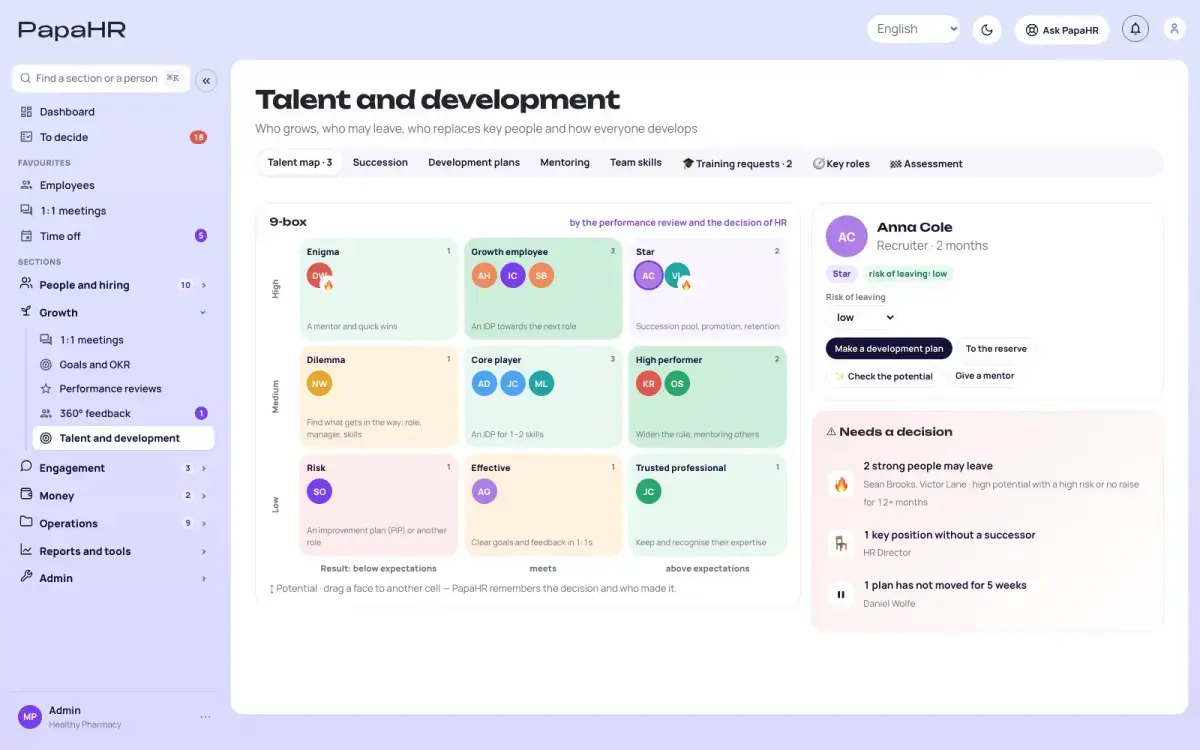
- Freefor up to 25 employees
- 30+modules — from the job opening to the exit interview
- 18ready-made surveys
- 5interface languages
- Telegram · Slack · Teamsand works on your phone
How many observers?
The first question when planning an assessment center is how many participants and how many assessors. Enter the number of participants: the estimate follows the rules from classes 1 and 3.
Participants in the assessment center
14–6 — most common12 — maximum
Typical size: most assessment centers have 4–6 participants.
Your estimate
- 3–12observers: 0.5 to 2 per participant
- 1group for the group discussion — ideally 6 people per group
Ideally, each observer sees every participant, but each one in no more than one exercise. The team needs a balance of psychologists or HR and line managers.
Assessment planning — class 3 · observer–participant matrix — class 5
Get the course — $350 →Watch a class before you pay.
A class in English, 31 minutes: what an assessment center is, why it matters, the course roadmap, key decisions and common mistakes.
You can discuss the course in the academy’s open Telegram chat for English-speaking students.
Join the chat →
6 classes: from the goal to the report and feedback.
Every class comes with an assignment based on your own company: goals and cost justification, a job competency profile, an exercise and memorandum, observer preparation, an observer–participant matrix, a report template.
01What an assessment center is
- The method and its key features
- Origins and growth of assessment centers
- Validity of assessment centers
- Where to start and how to make the case for an assessment center
- Whether to bring in consultants; assessment center vs development center
- Assignment: describe the goals of an assessment center for your company and justify its cost
02Job requirements
- Job analysis and its methods
- Behavioral event interview
- Which competencies to assess
- Competency profile and behavioral indicators; competency libraries
- Assignment, your choice: run a behavioral event interview and list the competencies for a role — or pick 5 competencies for your role from any library with 3–5 behavioral indicators each
03Assessment center content and planning
- Assessment center memorandum
- Competency–exercise matrix
- Exercise types: group discussions, role play, in-basket, presentation, information analysis; designing exercises
- Other methods: interviews and tests
- How many experts take part; the assessment center schedule
- Assignment, your choice: match exercises to the competencies from class 2, design one exercise or write a memorandum
04Training observers (assessors)
- How to choose observers and how many you need
- What makes a good assessor
- How to train observers: observing and rating behavior
- Observer report form
- Assignment, your choice: prepare a presentation for observer training, or choose three assessors in your company and explain why you chose them
05Running the assessment center
- Opening the session
- Briefing observers and participants
- Running exercises and quality control
- Closing the assessment and the observers’ wash-up discussion
- Assignment: an observer–participant matrix for your exercises, number of observers and participants
06After the assessment center
- Results report
- Feedback to and from participants
- Development plan
- Checking how the assessment worked (validation)
- Assignment: a report template for your assessment center
One course — or the whole academy.
This course
All 6 recorded classes, homework review and a diploma. 1 year of access.
Get the course →Annual subscription
175+ academy courses, 155+ already in English — including this one, Competency Model and 360 Feedback. Classes, homework review and diplomas for every course.
Subscribe →With the Competency Model course — $660. First define the competencies, then assess them in an assessment center.
Two courses — $660 →Three courses: + 360 Feedback — $990. Three employee assessment methods in one bundle.
Three courses — $990 →From payment to diploma.
- Classes at your own paceVideo, slides and materials for every class are in your student account, on desktop or phone. 1 year of access.
- Homework with reviewEvery class has an assignment based on your own company: goals and cost justification, a job competency profile, an exercise and memorandum, an observer–participant matrix, a report template. You get feedback on each one.
- Case discussions in the chatParticipants discuss their cases in the Telegram chat.
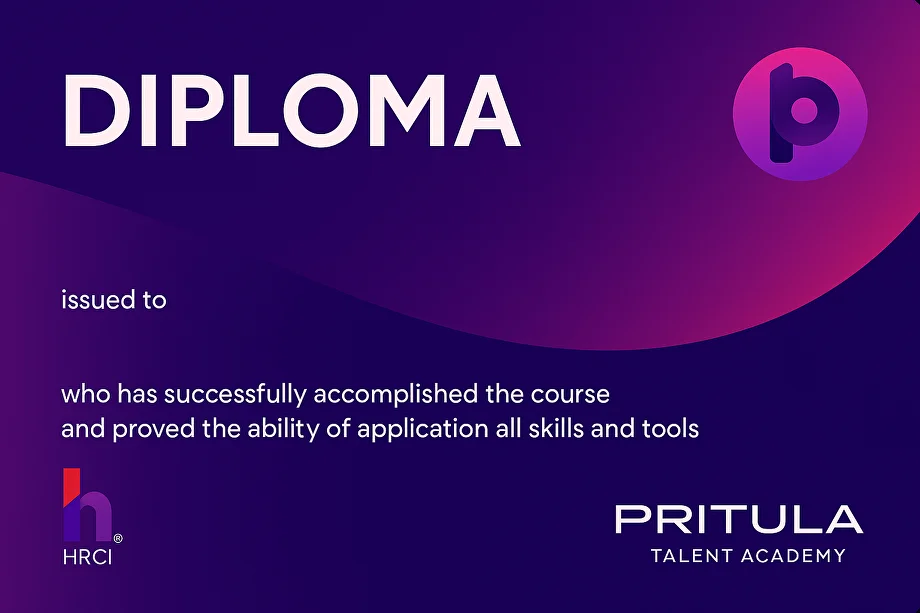
- DiplomaComplete the course assignments and get an Accredible diploma with a unique code.
Learn on your phone
The course fits in your pocket.
- Same login as on desktopVideo, slides and files for every class — in the iPhone and Android app.
- Synced progressStart a class at your desk — finish it on the way home.
- Homework from your phoneOpen the assignment, write your answer, attach a file and submit it for review.
A diploma that shows on LinkedIn.
After the course you receive a diploma in your name on Accredible — the same platform that issues certificates for Google, Udacity and Kaplan University.
- ✓ A unique code on every diploma — impossible to forge
- ✓ The QR code leads to an online version an employer can verify
- ✓ Add it to your LinkedIn profile in one click
- ✓ Available in English

Taught by Udemy’s #1 HR instructor.
The academy is built on Mike’s 21 years of HR practice.
- #1 HR instructor on Udemy — 1.9M enrollments
- PapaHR is free for up to 25 employees
- 21 years in HR: Wargaming, Preply, iDeals, Starlightmedia, Alfa-Bank, PeopleForce
- Certifications PHRi, SHRM-CP, HCI sHRBP; HRCI representative in Eastern Europe
- Two YouTube Silver Play Buttons
How the academy teaches.

“The course gave me more confidence in my own experience, which let me change jobs and broaden my role. You change people’s lives!”Zhanna MatsiashHRD, FlitMonitoring LinkedIn profile →

“During the course I took a fresh look at my role as an HR Business Partner: I learned to think more strategically, back decisions with numbers and build systematic analytics.”Elena ZoteaHR Business Partner, Dyninno Moldova LinkedIn profile →

“Studying grading systems, Scorecard and modern recruitment methods was especially useful.”Nigora SaydulloevaHuman Capital Management Director, AG Management LinkedIn profile →

“This course helped me look at my work more systematically, assess myself and review all my processes.”Svetlana SmirnovaHRD, CeoA LinkedIn profile →
Reviews from graduates of the HR Director course, taken from the surveys they fill in when they receive their diploma. We don’t yet have Assessment Center reviews with a photo and profile link.
Frequently asked questions.
What is an assessment center?
An assessment center is a method of employee assessment, not a place. A group of participants completes exercises that simulate real work; trained observers rate each person against behaviors defined in advance, and the final decision is made together.
What is an assessment center used for?
For selection and hiring, promotion, building a talent pipeline, spotting potential and identifying training needs. When the results are used to develop participants, it is a development center.
How is an assessment center different from a development center?
An assessment center works like a selection process: rating against a standard set in advance, a pass/fail outcome and feedback later in a report. A development center works like a training program: it uncovers potential and gives feedback right away.
What exercises are used in an assessment center?
Group discussions (cooperative and competitive), role plays, in-basket, written analysis, presentations, plus interviews and tests. Exercises are chosen with a competency matrix: 3 exercises for the most important competencies, 1–2 for the rest.
How long does an assessment center last and how many people take part?
From a few hours to a few days. Most often 4–6 participants, 12 at most; for a single participant it serves as a final check before hiring.
How many observers (assessors) do you need?
0.5 to 2 per participant, depending on the number of exercises, criteria and participants. Ideally, each observer sees every participant, but each one in no more than one exercise.
Who can be an assessor?
The observer team needs a balance of psychologists or HR specialists and line managers. All of them must be trained — choosing and training assessors is covered in class 4.
How accurate is an assessment center?
According to the data in class 1, the predictive validity of assessment centers for promotion is 0.65, versus 0.19 for interviews. The higher the validity, the better the assessment matches the person’s later performance.
How do you run an assessment center?
Set the goals and job requirements, build the competency–exercise matrix, design the exercises and schedule, train the observers, run the assessment center, prepare the report and give feedback. Each step has its own class in the course.
How long are the classes?
22 to 39 minutes each, about 3 hours of video in total. All 6 classes are recorded.
Is the course included in the subscription?
Yes. The $1,000 annual subscription opens 175+ academy courses, 155+ already in English — including this one, Competency Model and 360 Feedback.
How long is the access?
1 year from the day your student account opens.
Will I get a diploma?
Yes. Complete the course assignments and get a diploma in your name on Accredible, with a unique code and online verification. Available in English.
More employee assessment courses
Still have questions? Write to us.
Telegram WhatsApp info@pritula.academy Academy student chat on Telegram →