On-demand course · 12 lessons
Company Financial Management
Connect strategy, budget and KPIs into one system — and catch deviations before they turn into losses.
Or 175+ courses — $1,000 a year

Kostyantyn Yerokhin — course author, former CFO of ELEKS and Finance Director at Intellias, PhD in Economics (Candidate of Sciences).
Company goals for the yearFrom strategy to metrics1
exampleStrategic goal2Revenue +25% with no headcount growth
- FinanceNet profit, $K120104
- CustomersCustomer retention85%88%
- ProcessesOrder lead time3 days4 days
- PeopleAnnual turnover≤ 12%10%
Profit is 13% below plan — we break down the variance by budget line3
- 1Business modellesson 2
- 2Strategy pyramidlesson 7
- 3Budgetlesson 8
- 4KPIs: customers, people, processes, financelesson 9
Our students work at
























What is company financial management?
Company financial management is the planning, accounting and control of a business’s money: revenue, costs, profit and cash flow. It includes financial goals, a budget, performance indicators and regular plan-versus-actual reviews. The aim is a company that earns money, stays solvent and has funds to grow.
The course shows how to connect a company’s mission, strategy and goals with financial, customer, process and people metrics — and build a system you won’t have to rebuild when the business grows or hits a crisis.
What the course covers
- Efficiency-driven business
- Which financial metrics show how efficiently a company works Lesson 1
- Business model
- How to turn strategy into financial goals; models from startup to corporation Lessons 2–3
- Mission in numbers
- How to build the mission and vision into financial targets Lesson 4
- Processes and goals
- Inefficient parts of processes, goal-setting methodology Lessons 5–6
- Strategy, budget, KPIs
- Strategy pyramid, budget, metrics: customers, people, processes, finance Lessons 7–9
- Efficiency and growth
- Lean Six Sigma in finance, scaling a startup, the path to an innovation-driven business Lessons 10–12
Twelve lessons built around one end-to-end business model: lesson by lesson you build its strategy, goals, processes and metrics.
Who the course is for
Managers and directors
Understand how decisions about people, processes and customers affect profit, and speak the same language as your CFO.
Founders and business owners
Build a financial model you won’t have to redo when the business grows or hits a crisis.
Finance professionals and economists
Connect the budget and reporting with the company’s strategy and KPIs, not just count the numbers.
HR directors and HR business partners
Link people metrics to the business’s financial goals and defend the HR budget with numbers.
One more thing — PapaHR
Try the HR platform built by Mike Pritula, the academy’s founder.
Business finance is also about people: payroll, turnover, hiring. PapaHR keeps these numbers at hand — the things we cover in the lessons on goals, budget and KPIs:
- HR budget by line itemPlan, actuals and a full-year forecast by line item and month. The budget is approved right on the platform.Lesson 8
- HR in moneyWhat employee turnover and early leavers cost the company — with ready-to-use text for your CEO.Lesson 9
- OKR goalsCompany and team goals on the same platform as employees, performance reviews and 1:1 meetings.Lesson 6
- Surveys and eNPS18 ready-made surveys: the “people” metrics in your KPIs — engagement and willingness to recommend the company.Lesson 9
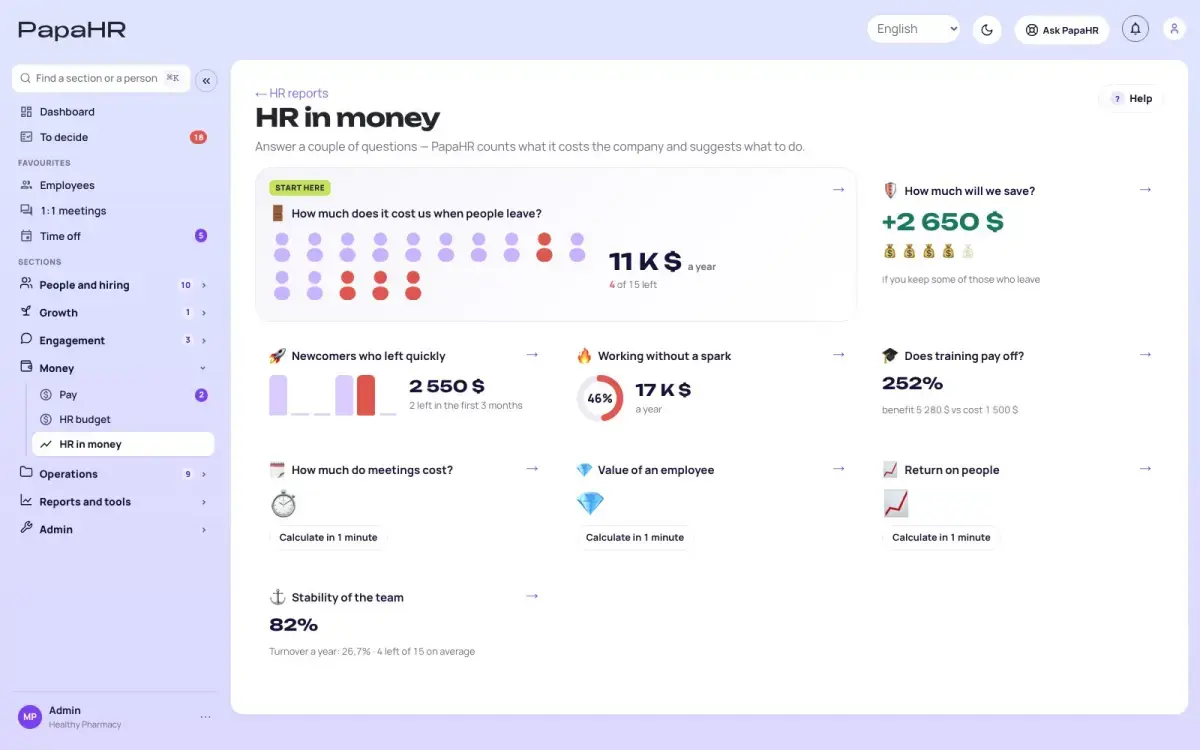
- Freefor up to 25 employees: employees, time off, surveys
- Prowith an academy subscription — up to 50 employees: all sections
- 18ready-made surveys
- 5interface languages
- Telegram · Slack · Teamsplus a mobile app
Where does your budget lose profit?
A budget isn’t about “using up the money” — it’s about management decisions; that’s Lesson 8. Enter plan and actuals by line item in thousands of dollars: the calculator works out profit and margin and shows which line pulled the result furthest from plan.
Example: a company’s quarterly budget, $K
The default lines and numbers are an example, not course data. Plug in your own budget.
Profit: actual vs plan
- Planned profit
- Actual profit
- Margin: plan → actual
Financial planning and budgeting — Lesson 8; performance metrics — Lesson 9.
Watch a lesson before you pay.
The full Lesson 1 in English, 59 minutes: what an efficiency-driven business is — how to optimize your business model and which financial metrics help measure how efficiently the company works.
You can discuss the course in the academy’s Telegram chat for English-speaking students (request to join).
Join the chat →
12 lessons: from business model to budget and KPIs.
The course is built around one end-to-end business model: lesson by lesson you set its strategy and goals, design processes and fill the system with metrics — financial, customer, process and people. Every lesson comes with homework and feedback.
01What does efficiency-driven business mean?
- How to optimize your business model and which financial metrics help measure how efficiently the company works
02Why is business modeling so important?
- How to turn strategy into a clear set of financial goals, lay the groundwork for scaling and see what resources you need to reach the goals
03The evolution of business models
- Different approaches to modeling at different stages of a business — from startup to global corporation
04Mission, vision, values: practical application
- How to build the mission and vision into financial targets, and why it matters to remember the people behind any metric
05Business process management
- How to build process chains and find the inefficient parts of a company
06Goal-setting methodology
- How to set goals people believe are achievable and get the team committed to reaching them
07Business strategy pyramid
- How to connect even small tasks to the business’s mission and keep that link when moving from strategy to tactics
08Financial planning and budgeting: keep it simple
- Budgets and plans aren’t about “using up the money” — they’re about sound, effective management decisions
09KPIs and performance metrics: customers, people, processes, finance
- How to build performance metrics so that KPIs don’t kill a successful business or employee motivation
10Lean Six Sigma: a focus on financial efficiency
- Applying Lean to a business’s financial processes
11How to build a scalable business from a startup
- How a solid financial model helps you grow without rebuilding processes at every growth spurt
12What’s next: from efficiency-driven to innovation-driven
- The future of financial modeling — what to think about today
One course — or the whole academy.
This course
All 12 recorded lessons, homework review and a diploma. 1 year of access.
Get the course →Annual subscription
175+ academy courses, 155+ already in English — including this one, CFO: Chief Financial Officer and Business and Finance for HR. Lessons, homework review and diplomas for every course.
Subscribe →For teams
A subscription to 175+ courses (155+ in English) for a team of up to 10 — for example, the managers who own their departments’ budgets.
Buy for your team →From payment to diploma.
- Lessons at your own paceVideo, slides and materials for every lesson are in your student account, on desktop or phone. 1 year of access.
- Homework with reviewA practical assignment for every lesson, with feedback.
- Questions in the chatYou can discuss the course and your own cases in the academy’s Telegram chat for English-speaking students (request to join).
- DiplomaComplete the course assignments and get an Accredible diploma with a unique code.
Learn on your phone
The course fits in your pocket.
- Same login as on desktopVideo, slides and files for every lesson — in the iPhone and Android app.
- Synced progressStart a lesson at your desk — finish it on the way home.
- Homework from your phoneOpen the assignment, write your answer, attach a file and submit it for review.
A diploma that shows on LinkedIn.
After the course you receive a diploma in your name on Accredible — the same platform that issues certificates for Google, Udacity and Kaplan University.
- ✓ A unique code on every diploma — impossible to forge
- ✓ The QR code leads to an online version an employer can verify
- ✓ Add it to your LinkedIn profile in one click
- ✓ Available in English
Taught by Kostyantyn Yerokhin.
More than 20 years in finance: from chief accountant to finance director of IT companies.
- CFO of ELEKS (2014–2017) and Finance Director at Intellias (2017–2020)
- Built the finance function: strategy, budgeting, controlling, reporting, KPI-based incentives
- PhD in Economics (Candidate of Sciences), associate professor — taught financial management for 16 years
- CIMA CertPM certificate
- Author of 150+ articles and 10 books on accounting, tax and financial management
How the academy teaches.

“The course is very constructive and easy to follow: afterwards I realized HR needs to look wider, think strategically and analyze every project and situation. … Now I read financial statements with confidence.”Balzhan MyrzabayevaDuring the course: HR consultant ↑ Now: First Deputy CEO, QAZAQ-ASTYQ GROUP Profile on LinkedIn →

“For me, the most important topics were strategic management, the role of HR in running the business, and the organization’s finances. … I liked the case-based teaching — for example, working through the finances of a sample project.”Dariia MelnykDuring the course: HR Manager, Claryfi Now: HR Operations Partner, JustMarkets Profile on LinkedIn →
Reviews come from the surveys graduates fill in when they receive their diploma: about the academy’s Business and Finance for HR course. The Company Financial Management course does not yet have reviews with a photo and a profile link.
Frequently asked questions.
What is company financial management?
The planning, accounting and control of a business’s money: revenue, costs, profit and cash flow. It includes financial goals, a budget, performance indicators and regular plan-versus-actual reviews, so the company earns money, stays solvent and has funds to grow. Lesson 1 covers which financial metrics show how efficient a business is.
What does company financial management include?
Financial planning and budgeting, accounting for revenue and costs, cash-flow control, performance metrics and analysis of deviations from plan. Budgeting is Lesson 8; KPIs and metrics are Lesson 9.
How is profit different from cash flow?
Profit is the difference between revenue and costs for a period, shown in the profit and loss statement (P&L). Cash flow is the actual movement of money in the accounts. A company can be profitable and still not have the cash to pay its current bills.
Why do managers need to understand finance?
To see how decisions about people, processes and customers affect business results, set measurable goals and spot deviations from plan in time. Financial performance metrics are covered in Lesson 1; KPIs for customers, people, processes and finance in Lesson 9.
How do you link company strategy to financial goals?
Through the business model and the strategy pyramid: the mission and strategy become a set of financial goals, and the goals become team tasks. Business modeling is Lesson 2, goal setting Lesson 6, the business strategy pyramid Lesson 7.
How do you build a company budget?
Start from goals and management decisions, not from “using up the money”, and keep the budget simple. Financial planning and budgeting is Lesson 8; the plan-versus-actual calculator is above on this page.
Which KPIs does a company need?
Metrics in four areas — customers, people, processes and finance — linked to strategy. KPIs shouldn’t kill employee motivation or the business itself. KPIs and performance metrics are covered in Lesson 9.
Who is the course for?
Managers and directors, founders and business owners, finance professionals and economists, HR directors and HR business partners — anyone who wants to understand business finance and connect it to strategy.
Can I take the course online?
Yes. All 12 lessons are on demand, each with homework and feedback. After the course you get a diploma in your name on Accredible that can be verified online.
Is the course included in the subscription?
Yes. The $1,000 annual subscription opens 175+ academy courses, 155+ already in English — including this one, CFO: Chief Financial Officer and Business and Finance for HR.
How long do I have access?
1 year from the moment your account is opened.
Can I study on my phone?
Yes. Lessons open in the app for iPhone and Android with the same login and password as on your computer, and your progress syncs.
Will I get a diploma?
Yes. Complete the course assignments and get a diploma in your name on Accredible with a unique code and online verification.
More courses on finance and business
Still have questions? Write to us.
Telegram WhatsApp info@pritula.academy Telegram chat for English-speaking students (request to join) →