On-demand course · 8 lessons
Business Process Optimization
Find where work sits waiting in line — and remove it, without hiring more people.
Or 175+ courses — $1,000 a year

Mike Pritula — course author, founder and head of strategy at Pritula Academy, founder of PapaHR, 21 years in HR.
Paying a supplier invoiceProcess map1
example- 1Request drafted15 min
- waits 4 h2
- 2Manager approved5 min
- waits 24 h
- 3Finance checked20 min
- waits 48 h3
- 4Director signed5 min
- waits 24 h
- 5Paid10 min
Work55 min
Lead time4.2 days
Work share< 1%
Team idea: check the invoice in parallel with the signature4
- 1Flowchartlesson 3
- 2Waste: waitinglesson 2
- 35 Whyslesson 6
- 4Improvement culturelesson 8
Our students work at






















What is process optimization?
Business process optimization is the systematic improvement of how work gets done in a company: removing unnecessary steps and waiting, standardizing what repeats and automating routine work. The goal is a process that delivers the right result faster, cheaper and more reliably.
All work in a company is a process — from a purchase request to hiring an employee. Broken processes lead to errors, delays and bottlenecks, and new technology without redesigning the process doesn’t solve the problem. This is covered in Lesson 1.
What the course covers
- The process
- Inputs, activities, outputs, resources, control; core, support and management processes Lesson 1
- Waste and standards
- What waste is, standardization, process maturity, the five phases of improvement Lesson 2
- Process maps
- Flowchart, cross-functional map, value stream map Lesson 3
- Managing improvement
- The link to strategy, phases from planning to implementation Lesson 4
- Process architecture
- Process architecture and process modeling Lesson 5
- Tools
- 5S, 5 Whys, 8D, cause-and-effect diagram, SIPOC, prioritization matrix Lessons 6–7
- Improvement culture
- How to change people’s behavior, the role of managers and HR Lesson 8
Eight lessons — from what a process is to a culture where processes keep improving.
Who the course is for
Department heads
Find where your team loses time and restructure the work without hiring more people.
HR professionals and HR directors
Improve HR processes and help the business change its culture — the role of HR gets its own topic.
Operations managers and COOs
Master process maps and improvement tools and roll out changes step by step.
Founders and business owners
Make the way the company works predictable, so it depends less on manual control.
One more thing — PapaHR
Try the HR platform Mike built.
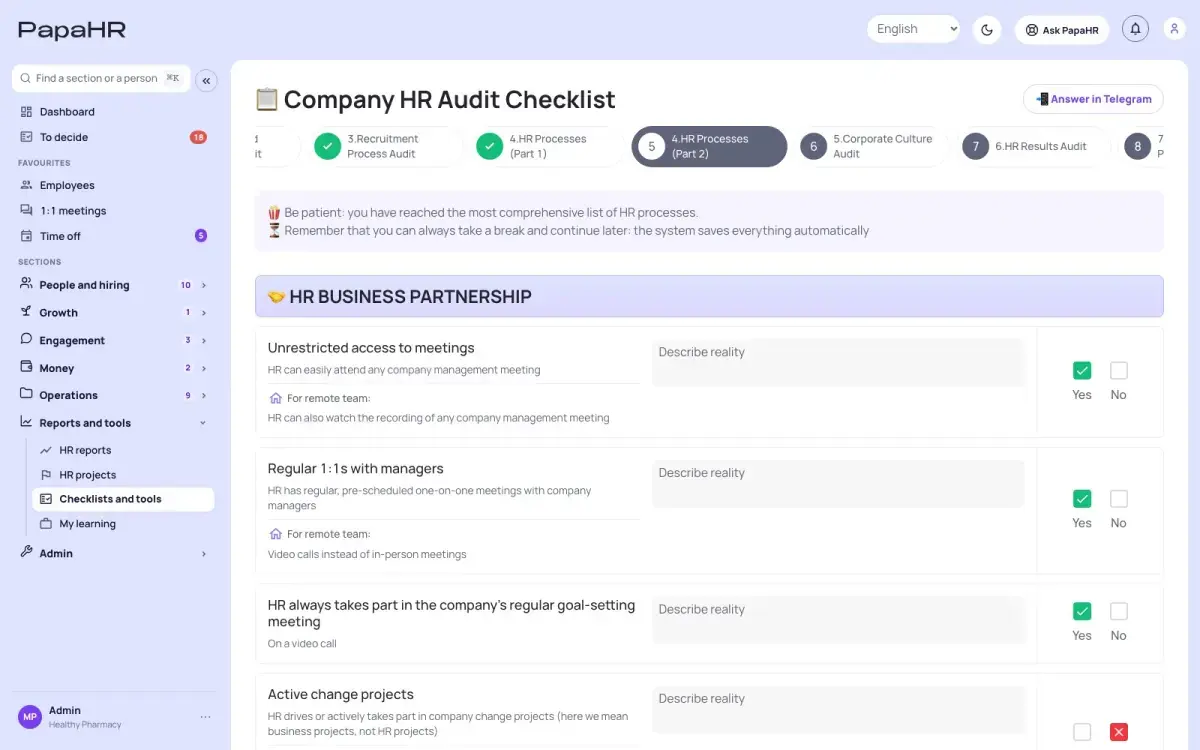
Processes are improved by people. PapaHR has tools for that — the things we cover in the lessons on standards, implementation and improvement culture:
- Idea boxEmployees suggest improvements, vote for the best ones and see the status and response for every idea.Lesson 8
- Approvals and request formsRequests follow an approval route on the platform instead of getting lost in email and messengers.Lesson 3
- Checklists and knowledge baseThe process standard is written down and available to everyone — newcomers do it the same way as experienced staff.Lesson 2
- HR audit699 questions with hints, and at the end a report with recommendations: where the bottlenecks are in your HR processes.Lesson 2
- Freefor up to 25 employees: checklists, knowledge base, surveys
- Prowith an academy subscription — up to 50 employees: all sections
- 18ready-made surveys
- 5interface languages
- Telegram · Slack · Teamsplus a mobile app
How much of your process time is actual work?
Waiting is one of the types of waste we cover in Lesson 2. Enter the steps of your process: how many minutes people actually work on it and how many hours it waits for the next step. The calculator shows what share of the lead time is work and what share is waiting.
Example: paying a supplier invoice
The default steps and numbers are an example, not course data. Plug in your own process.
Share of work in the process lead time
- Work
- Waiting
- Lead time
Waste and where to start improving — Lesson 2; the flowchart and the value stream map — Lesson 3.
Watch a lesson before you pay.
The full Lesson 1, 31 minutes: the PDCA improvement cycle, what a process is — inputs, outputs and resources, formal and informal processes, the benefits of process improvement, and case studies including Nike and Colgate.
You can discuss the course in the academy’s Telegram chat for English-speaking students (request to join).
Join the chat →
8 lessons: from a process map to a culture of improvement.
The course moves from the basics to a system: what a process and waste are, how to map processes and manage their improvement, process architecture, basic and advanced optimization tools, and a culture where processes keep improving. Every lesson comes with homework and feedback.
01What is process optimization?
- What a process is
- The characteristics of a process
- Different types of processes
- What process improvement is
- The benefits of process improvement
02Basic concepts of process improvement
- Core values of process improvement
- What drives process improvement
- What waste is
- What standardization is
- What process maturity is
- The five phases of process improvement
- Where to start
03Process mapping
- What process mapping is and why it helps
- How mapping differs from modeling
- Stakeholder map and relationship map
- Flowchart and cross-functional map
- Value stream map
- What process maps are made of
- Stages of process mapping
04Process improvement management
- A process improvement framework
- How process improvement connects to strategy
- Phases of improvement: from planning to implementation
05Process architecture
- What process architecture is
- Benefits of process architecture
- Process-oriented architecture
- What process modeling is
- How to manage process modeling
- Where to start
06Process optimization tools
- What problem solving is
- 5S, 5 Whys, 8D
- Activity network diagram, affinity diagram, benchmarking
- Brainstorming and checklists
- Cause-and-effect diagram, flow diagram
07Advanced process optimization tools
- Linear regression
- Nominal group technique
- Prioritization matrix
- SIPOC
- SWOT, DRIVE, ICOR
- Problem-solving funnel
08A culture of process improvement
- What a process improvement culture is
- Phases of culture change
- Components of an excellent culture
- How to change people’s behavior
- The role of managers
- The role of HR
One course — or the whole academy.
This course
All 8 recorded lessons, homework review and a diploma. 1 year of access.
Get the course →Annual subscription
175+ academy courses, 155+ already in English — including this one, Process Description, Organizational Structure and Chief Operating Officer. Lessons, homework review and diplomas for every course.
Subscribe →For teams
A subscription to 175+ courses (155+ in English) for a team of up to 10 — for example, the department heads who will improve processes.
Buy for your team →From payment to diploma.
- Lessons at your own paceVideo, slides and materials for every lesson are in your student account, on desktop or phone. 1 year of access.
- Homework with reviewA practical assignment for every lesson, with feedback.
- Questions in the chatYou can discuss the course and your own cases in the academy’s Telegram chat for English-speaking students (request to join).
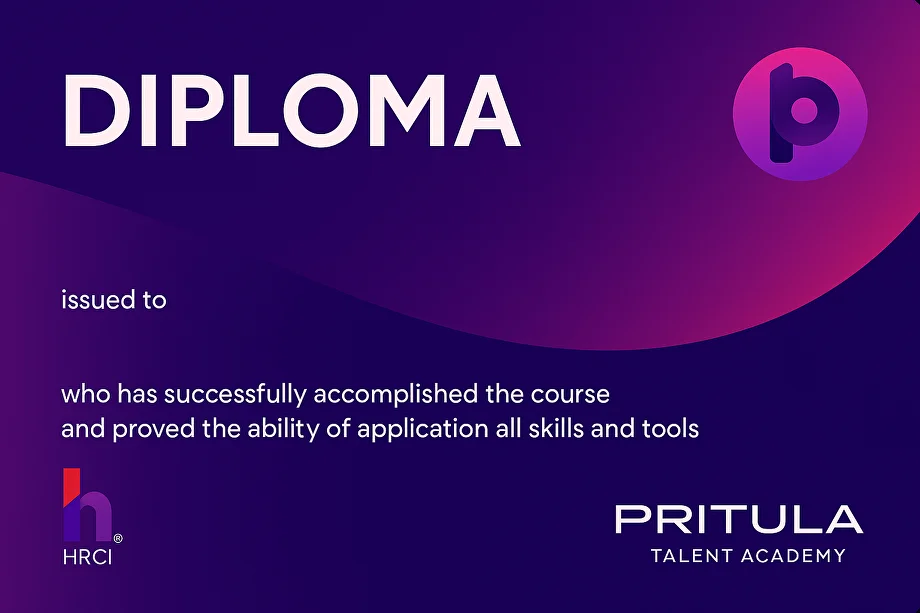
- DiplomaComplete the course assignments and get an Accredible diploma with a unique code.
Learn on your phone
The course fits in your pocket.
- Same login as on desktopVideo, slides and files for every lesson — in the iPhone and Android app.
- Synced progressStart a lesson at your desk — finish it on the way home.
- Homework from your phoneOpen the assignment, write your answer, attach a file and submit it for review.
A diploma that shows on LinkedIn.
After the course you receive a diploma in your name on Accredible — the same platform that issues certificates for Google, Udacity and Kaplan University.
- ✓ A unique code on every diploma — impossible to forge
- ✓ The QR code leads to an online version an employer can verify
- ✓ Add it to your LinkedIn profile in one click
- ✓ Available in English

Taught by Udemy’s #1 HR instructor.
The academy is built on Mike’s 21 years of HR practice.
- 2M+ enrollments on Udemy
- Founder of PapaHR, an AI-native HR platform — free for up to 25 employees
- 21 years in HR: Wargaming, Preply, iDeals, Starlightmedia, Alfa-Bank, PeopleForce
- Certifications PHRi, SHRM-CP, HCI sHRBP; HRCI representative in Eastern Europe
- Two YouTube Silver Play Buttons
How the academy teaches.

“I discovered a wide range of useful tools and frameworks that directly support the responsibilities of a COO.”Svitlana KlymenkoDuring the course: CMO ↑ Now: COO, Sales Label Consulting Profile on LinkedIn →
“I used to think like an HR person, mostly on the side of ‘the people.’ Now I think bigger and understand the need for balance — not only for the staff, but for the business too. We applied a lot of it in the company, and there are improvements.”Svitlana TysiachnaDuring the course: Human Resources Lead ↑ Now: Chief Operating Officer, SelfStartGlobal Profile on LinkedIn →

“The homework is essentially your actual job — what your employer will ask of you, and you’ll already have it ready.”Anna ShkarletDirector of Operations, Empire English School Profile on LinkedIn →
Reviews from graduates of the Chief Operating Officer course, which covers a company’s operational processes, taken from the surveys graduates fill in when they receive their diploma. The Business Process Optimization course does not yet have reviews with a photo and a profile link.
Frequently asked questions.
What is business process optimization?
The systematic improvement of how work gets done in a company: removing unnecessary steps and waiting, standardizing what repeats and automating routine work, so the process delivers results faster, cheaper and more reliably. What a process is and why to improve it is covered in Lesson 1.
How is process optimization different from process description?
A description records how a process works today. Optimization changes it: it finds waste and bottlenecks and restructures the work. Describing processes is a separate academy course, Process Description, which you can take together with this one.
Where do you start optimizing processes?
With understanding waste, standardization and process maturity, and the five phases of improvement — where to start is covered in Lesson 2. Then the process is mapped to see where it loses time — Lesson 3.
What tools are used for process optimization?
Basic ones: 5S, 5 Whys, 8D, the cause-and-effect diagram, benchmarking, brainstorming and checklists (Lesson 6). Advanced ones: SIPOC, the prioritization matrix, the nominal group technique and linear regression (Lesson 7).
What is a process map?
A diagram that shows who does what, and in what order, in a process. Types include the flowchart, the cross-functional map, the value stream map and others. Process mapping is covered in Lesson 3.
What is the role of HR in process optimization?
Process improvement relies on culture: people have to change their habits. How to change people’s behavior and the role of managers and HR are covered in Lesson 8.
Who is the course for?
Department heads, HR professionals and HR directors, operations managers and COOs, founders — anyone who wants the company to work faster and more predictably.
Can I take the course online?
Yes. All 8 lessons are on demand, each with homework and feedback. After the course you get a diploma in your name on Accredible that can be verified online.
Is the course included in the subscription?
Yes. The $1,000 annual subscription opens 175+ academy courses, 155+ already in English — including this one, Process Description and Chief Operating Officer.
How long do I have access?
1 year from the moment your account is opened.
Can I study on my phone?
Yes. Lessons open in the app for iPhone and Android with the same login and password as on your computer, and your progress syncs.
Will I get a diploma?
Yes. Complete the course assignments and get a diploma in your name on Accredible with a unique code and online verification.
More courses on processes
Still have questions? Write to us.
Telegram WhatsApp info@pritula.academy Telegram chat for English-speaking students (request to join) →