01 · Train the Trainer · Recorded
Course Train the Trainer training that changes behavior, not just training people like.
For business trainers, in-house trainers, HR and managers. 6 recorded classes: the trainer’s role, program design, delivery with Kolb’s cycle, group dynamics and resistance, a trainer’s toolkit, and online learning.
Recorded course · start with a free class in English
- 6recorded classes
- Taskson your own training
- 1 yearof access
- Diplomaon Accredible

Mike Pritula — founder of Pritula Academy and PapaHR, 21 years in HR.
Our students work at
























Train the Trainer — what is it?
Train the Trainer is training for people who teach others: business trainers, in-house trainers, HR and managers. It teaches the craft of training rather than a subject: how to design a program, run a session, keep the group engaged and check that it worked.
Adults often come to training not because they want the knowledge but because their manager sent them. That’s why a good session follows Kolb’s cycle: participants first run into a problem themselves, then discuss what happened, work out a model with the trainer, and practice it.
The course covers both in-person training and online learning: webinars, technical setup and lessons with quizzes in an LMS.
How many participants per session — class 2
- 1–6
- The session is less dynamic Small
- 4
- One toxic participant can easily derail the session — in a group of 16, that’s much harder Risk
- 18–20
- Far more group energy than in a group of 8–12 Energy
- 50–300
- A mega-training that needs different methods Different format
The same class covers the room (oval seating), coffee breaks, badges and markers.
| Level | What’s evaluated | Methods |
|---|---|---|
| 1. Reaction | What participants think of the program | Checklist, questionnaire, interview |
| 2. Learning | How much participants’ knowledge grew | Tests before and after |
| 3. Behavior | How participants changed their behavior | Performance test, critical incident review, 360 survey, on-the-job observation |
| 4. Results | How the program affected business results | Cost-benefit analysis, return on investment |
Who the course is for
New business trainers
How the profession works, the types of training, and how to build your first program — from topic and audience to homework.
In-house trainers
Kolb’s cycle, group dynamics and resistance from participants “sent by their manager”.
HR and L&D specialists
Training programs, Kirkpatrick evaluation and online lessons with quizzes in an LMS.
Managers and experts
For those who teach their team or share expertise: models, metaphors and how to present theory so people actually use it.
After the session
Participant survey and materials — in one place.
Kirkpatrick level 1 is participant reaction, gathered with a questionnaire. In PapaHR, surveys, the knowledge base and onboarding checklists are part of the free plan for up to 25 employees: put your post-training feedback form and materials there. There are 18 ready-made survey templates.
Try PapaHR for free →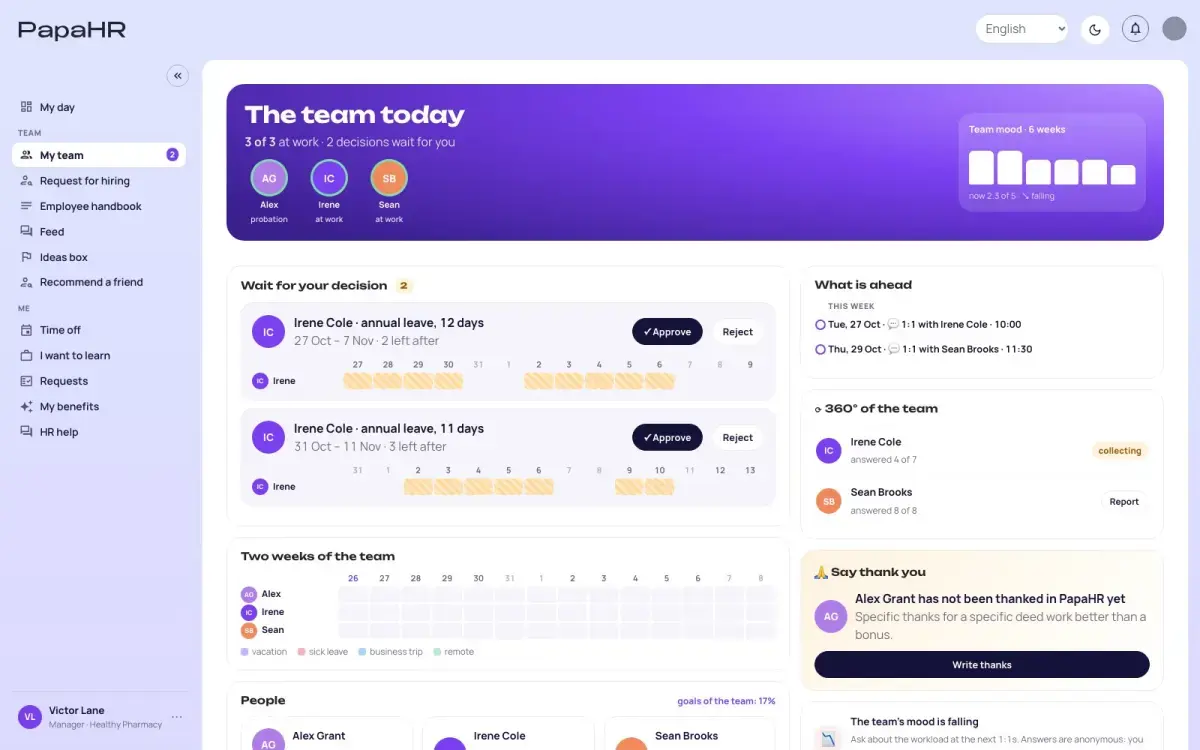
- Freefor up to 25 employees: surveys, knowledge base, onboarding, checklists
- 30+modules — from the job opening to the exit interview
- 18ready-made surveys
- 5interface languages
- Telegram · Slack · Teamsand works on your phone
How do you evaluate your training?
The Kirkpatrick model from class 1 has four levels of training evaluation — from participant reaction to business results. Check what you already measure.
What you measure after training
Watch a class before you pay.
Class 1 in full, in English, 29 minutes: who a trainer is and how they work, formats and types of training, trainer styles, and evaluating training with the Kirkpatrick model.
You can discuss the course in the academy’s open Telegram chat for English-speaking students.
Join the chat →
6 classes: from the trainer’s role to online learning.
After each class there’s an assignment on your own training: why you want to train, a program and a problem-setting exercise, your own model for the topic, your team’s group dynamics, a metaphor and its moral, and an online lesson with quizzes.
01Who a trainer is and how they work
- Structure, content, style, follow-up and resistance
- Dale’s cone — the learning pyramid
- Learning event formats and types of training
- Trainer styles
- How to evaluate training: the Kirkpatrick model
- Assignment: answer what your big goal is, how training helps you reach it, and what resources you have and need
02Preparing to train
- Stage 1 of Kolb’s cycle: activation and problem setting
- Pre-training preparation
- Group size, the room, coffee breaks, badges and markers
- Designing the training program
- Assignment, your choice: write a training program — topic, audience, value proposition, 10–15 key points, homework and a first slide deck — or prepare a problem-setting exercise
03Delivering training
- Visual materials and the session schedule
- Trainer styles
- Cycle stages: reflection, conceptualization, practice
- A model for designing training
- Assignment: create your own model for your training topic — an acronym, diagram, cycle, matrix or formula
04Methodology: the group and resistance
- Group norms and warm-ups at the start
- Stages of group dynamics: forming, role allocation, steady work, closing
- Facilitation or moderation — what to choose and when
- Handling resistance and objections
- Assignment: identify your team’s Tuckman stage and describe how you’d run a session for it
05Useful tools
- Structure of a business training and how a trainer introduces themselves
- Aphorisms, metaphors and parables
- Introductions and participants’ personal goals
- Warm-ups and presenting theory
- Five rules for small-group work; how to close a session
- Assignment: choose a metaphor, link it to your training topic and write its moral
06Online learning
- Running effective webinars
- Technical setup for online learning
- Staying connected with an online group
- Assignment: build one lesson with quizzes in an LMS and send screenshots
After the course
What will show up on your profile.
Your Name
Corporate Trainer · Learning & Development
Experience
- Training program: audience, value proposition, 10–15 key pointsClass 2
- My own model for the training topicClass 3
- A session adapted to the group’s stageClass 4
- An online lesson with quizzes in an LMSClass 6
Licenses & certifications
Skills
- Training design
- Kolb’s cycle
- Facilitation
- Group dynamics
- Kirkpatrick model
- Online learning
Each experience line is a course assignment, with the class number next to it.
What L&D specialists earn in Europe
$4,200a month — average across 4 countries
€44,700 a year
- Germany$4,700
- United Kingdom$4,200
- Sweden$4,000
- Netherlands$3,800
PayScale, viewed 13 Nov 2026 (data updated in 2024–2026): median base salary of a Learning and Development Specialist before tax, excluding bonuses; average of the medians for 4 countries, each with at least 15 PayScale profiles. Converted at the ECB rate of 2 Nov 2026: €1 = $1.1216, £0.8358, SEK 10.9475. The course does not guarantee a job or salary.
One course — or the whole academy.
This course
All 6 recorded classes, homework review and a diploma. 1 year of access.
Get the course →Annual subscription
175+ academy courses, 155+ already in English — including this one, Facilitation and Coaching. Classes, homework review and diplomas for every course.
Subscribe →For teams
175+ courses, 155+ already in English, for a team of up to 10 people — for example, all your in-house trainers.
Buy for your team →With the Facilitation course — $660. Training teaches; facilitation helps a group reach its own decision. An in-house learning lead needs both.
Two courses — $660 →Three courses: + Coaching — $990. Training, facilitation and employee coaching in one bundle.
Three courses — $990 →From payment to diploma.
- Classes at your own paceVideo, slides and materials for every class are in your student account, on desktop or phone. 1 year of access.
- Homework with reviewEach class has an assignment based on your own training: your goal as a trainer, a program and a problem-setting exercise, your own model, group dynamics, a metaphor and its moral, and an online lesson with quizzes. You get feedback on each one.
- Questions in the chatYou can discuss the course and your own cases in the academy’s open Telegram chat for English-speaking students.
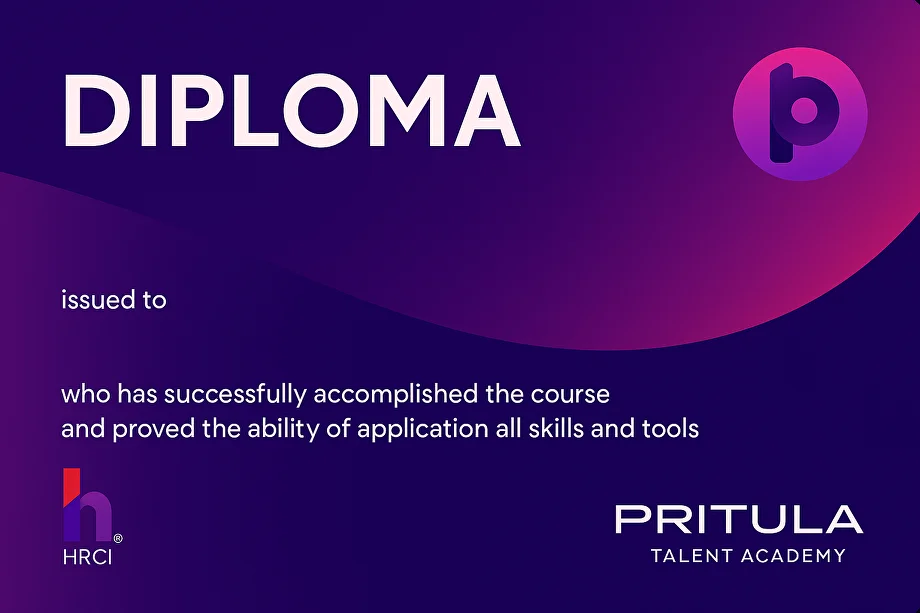
- DiplomaComplete the course assignments and get an Accredible diploma with a unique code.
Learn on your phone
The course fits in your pocket.
- Same login as on desktopVideo, slides and files for every class — in the iPhone and Android app.
- Synced progressStart a class at your desk — finish it on the way home.
- Homework from your phoneOpen the assignment, write your answer, attach a file and submit it for review.
A diploma that shows on LinkedIn.
After the course you receive a diploma in your name on Accredible — the same platform that issues certificates for Google, Udacity and Kaplan University.
- ✓ A unique code on every diploma — impossible to forge
- ✓ The QR code leads to an online version an employer can verify
- ✓ Add it to your LinkedIn profile in one click
- ✓ Available in English

Taught by Udemy’s #1 HR instructor.
The academy is built on Mike’s 21 years of HR practice.
- #1 HR instructor on Udemy — 1.9M enrollments
- PapaHR is free for up to 25 employees
- 21 years in HR: Wargaming, Preply, iDeals, Starlightmedia, Alfa-Bank, PeopleForce
- Certifications PHRi, SHRM-CP, HCI sHRBP; HRCI representative in Eastern Europe
- Two YouTube Silver Play Buttons
How the academy teaches.

“The course gave me more confidence in my own experience, which let me change jobs and broaden my role. You change people’s lives!”Zhanna MatsiashHRD, FlitMonitoring LinkedIn profile →

“During the course I took a fresh look at my role as an HR Business Partner: I learned to think more strategically, back decisions with numbers and build systematic analytics.”Elena ZoteaHR Business Partner, Dyninno Moldova LinkedIn profile →

“Studying grading systems, Scorecard and modern recruitment methods was especially useful.”Nigora SaydulloevaHuman Capital Management Director, AG Management LinkedIn profile →

“This course helped me look at my work more systematically, assess myself and review all my processes.”Svetlana SmirnovaHRD, CeoA LinkedIn profile →
Reviews from graduates of the HR Director course, taken from the surveys they fill in when they receive their diploma. We don’t yet have Train the Trainer reviews with a photo and profile link.
Frequently asked questions.
What is Train the Trainer?
Train the Trainer is training for people who teach others: business trainers, in-house trainers, HR and managers. It teaches the craft of training: how to design a program, run a session, keep the group engaged and check that the learning worked.
How do I become a corporate trainer?
Work out why you want to train and what resources you need, learn to design programs, run sessions with Kolb’s cycle, work with groups and use a trainer’s tools — then run sessions and gather feedback. The course covers this path in 6 classes with assignments on your own training.
Can I learn to be a trainer online?
Yes. All 6 classes are recorded; you do the assignments on your own training and get feedback. After the course you receive an Accredible diploma in your name with online verification.
What is Kolb’s cycle in training?
Four stages of how adults learn from experience: problem setting (participants face a task they can’t yet handle), reflection (discussing what happened), conceptualization (working out a model with the trainer) and practice (applying the model). Covered in classes 2 and 3.
How do you evaluate training effectiveness?
With the Kirkpatrick model, on four levels: participant reaction (questionnaire), learning (tests before and after), on-the-job behavior (observation, 360 survey) and business results (cost-benefit analysis). That’s class 1.
How many participants should a session have?
According to class 2: a group of 18–20 has far more energy than a group of 8–12; sessions for 1–6 people are less dynamic; and mega-trainings for 50–300 people need different methods.
How do you handle participant resistance?
Class 4 covers group norms, warm-ups, managing group dynamics by stage, and dealing with difficult behavior and objections — plus when to choose facilitation and when to choose moderation.
How do you run online training?
Class 6 covers running webinars, technical setup and keeping in touch with the group. The assignment is to build one lesson with quizzes in an LMS.
How long are the classes?
21 to 29 minutes each, about 2.5 hours of video in total. All 6 classes are recorded, with homework and feedback.
Is the course included in the subscription?
Yes. The $1,000 annual subscription opens 175+ academy courses, 155+ already in English — including this one, Facilitation and Coaching.
How long is the access?
1 year from the day your student account opens.
Can I study on my phone?
Yes. Classes open in the iPhone and Android app with the same login as on desktop, and your progress syncs.
Will I get a diploma?
Yes. Complete the course assignments and get a diploma in your name on Accredible, with a unique code and online verification. Available in English.
More courses on developing people
Still have questions? Write to us.
Telegram WhatsApp info@pritula.academy Academy student chat on Telegram →