01 · For managers · Recorded
Course People Management so your team works without you checking every step.
A course for managers and business owners. 13 recorded classes: a strong team, training, 1:1s and coaching, a deputy, motivation, pay and bonuses, retention, strategy and OKRs, teamwork and oversight.
Recorded course · start with a free lesson in English
- 13recorded classes
- Tasksbased on your team
- 1 yearof access
- Diplomaon Accredible

Mike Pritula — founder of Pritula Academy and PapaHR, 21 years in HR.
Our students work at























People management — what is it?
People management is a manager’s work with people: hiring and training, setting goals, motivation, feedback, development and checking results. The aim is a group that reaches a shared goal and can work without the manager constantly stepping in.
It isn’t micromanagement. Micromanagement means checking every step an employee takes. In people management, the manager sets goals and provides resources and feedback, and leaves the how to the team.
It’s time to build real people management when the manager does the team’s work, results drop whenever the manager is away, and strong people leave: the team depends on one person.
How many leadership styles managers use
- One style for everyone50%
- Two styles30%
- Three styles19%
- All four1%
Half of managers lead everyone the same way, even though a newcomer and an expert need different styles. Source: class 13.
| Style matches the employee’s level | Over-supervision | Under-supervision | |
|---|---|---|---|
| What the manager does | Matches the style to the person’s readiness: instructions for some, freedom for others | Manages too tightly and checks every step | Leaves people to sink or swim and delegates too much |
| What the employee gets | Exactly as much direction and support as they need right now | Can’t make decisions on their own | No instructions, support or help, though they aren’t ready to work alone |
Who the course is for
New managers
Specialists leading a team for the first time: 1:1 meetings, feedback, delegation and oversight without micromanagement.
Department heads
Motivation, pay ranges and bonuses, keeping strong people, and a deputy who can run things without you.
Business owners
Strategy, OKRs and A-players you can trust with a whole area, so the business doesn’t rest on you alone.
HR and HR business partners
To support managers: training policy, the 9-box matrix, succession, pay ranges and turnover metrics.
After classes 2 and 5
Potential and successors — on one map.
In class 2 you place your team on a potential matrix; in class 5 you build your bench. In PapaHR this is one talent map: development plans, successors and mentors, with 1:1s, OKRs and 360° feedback alongside. These sections are in the Pro plan, which the academy’s annual subscription includes for up to 50 employees.
Try PapaHR for free →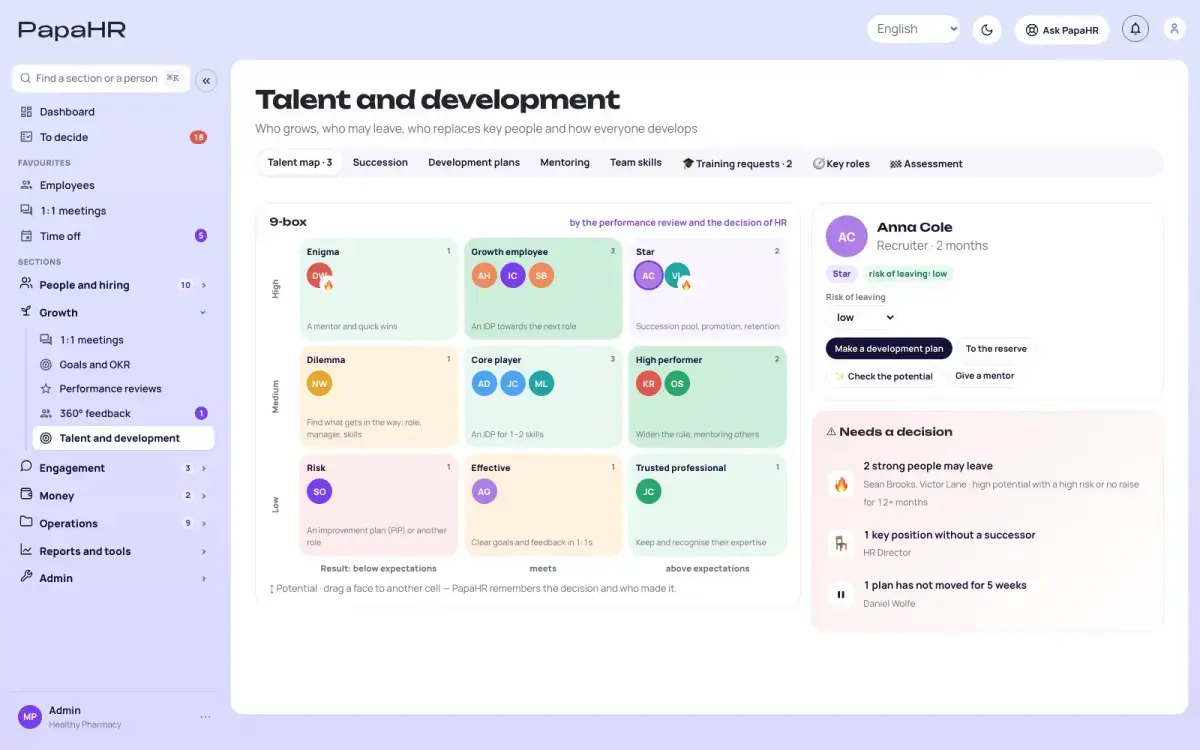
- Freefor up to 25 employees; talent map, 1:1s and OKRs are in Pro
- 30+modules — from the job opening to the exit interview
- 18ready-made surveys
- 5interface languages
- Telegram · Slack · Teamsand works on your phone
What does it cost when someone quits?
Compare the cost of losing a person with the cost of keeping them. The rule from class 9: replacing someone costs 3 to 36 monthly salaries; keeping them costs about 30% on top of their salary for a year.
Employee
Their role in the company
Your estimate
- $6,000is what losing this person costs the company
- $3,600is the cost of a year of retention: +30% salary
- 20months of retention covered by one prevented departure
Valuable people don’t leave only for money. Class 9 covers retention strategies, counteroffers and how to handle the conversation when someone brings you another job offer.
Cost of leaving and retention — class 9 · pay ranges — class 7 · motivation — class 6
Get the course — $400 →Watch a free lesson before you pay.
A free lesson in English, 52 minutes: what people management means in day-to-day work, a manager’s core responsibilities and decisions, and common mistakes.
You can discuss the course in the academy’s open Telegram chat for English-speaking students.
Join the chat →
13 classes: from a strong team to oversight without micromanagement.
Each class comes with an assignment based on your own team: an A-player profile, a potential matrix and development plan, a 1:1 with a report, a bench of successors, pay ranges, a bonus scheme, flight risk and retention cost, strategy, OKRs, a teamwork plan and employee development levels.
01A strong team
- Who you need: a profile of the ideal employee, the A-player
- Where to look: recruiters, job sites, agencies
- Turning individuals into a cohesive team
- Assignment: write the profile of your A-player
02Training employees
- A development needs survey, a training request form, a training policy
- The Kirkpatrick model and the 6D model
- Individual development plan
- The 9-box matrix and succession planning
- The 70-20-10 rule
- Assignment: place your team on a potential matrix and write a development plan for one employee
031:1 meetings
- Meeting template and rapport
- 1:1 questions for every situation
- Feedback and coaching in the meeting
- A checklist for diagnosing employee problems
- Report format and tools for tracking meetings
- Assignment: hold a 1:1 with feedback, check the employee against the 17-situation checklist and write a short report
04Coaching employees
- Core coaching competencies
- The GROW coaching model
- When coaching works and when it doesn’t
- The wheel of balance
- A coaching readiness checklist and a pre-session questionnaire
05Choosing a deputy
- Uncovering your employees’ talents
- Who to choose as your deputy
- Growing your future deputy
- Assignment: take a strengths test, find your top 5 and build a bench based on your employees’ talents
06Employee motivation
- Herzberg’s, Maslow’s and Daniel Pink’s motivation models
- Motivation, engagement, loyalty and employee experience: the difference
- Diagnosing demotivation
- Neel Doshi’s motivation assessment
- Assignment: have your team take the motivation test and propose steps to raise it
07Pay
- A pay management system and job evaluation
- Pay ranges and a merit increase matrix
- Compa-ratio, pay compression, green-circle and red-circle rates
- Lump sums instead of raises
- Assignment: enter your employees, their levels and pay into the template, compare with the market and find who needs a review
08Bonuses
- Target bonus for a role
- Daily, weekly, monthly and annual bonuses
- Fee-based pay and sales team bonuses
- Team bonuses
- Assignment: choose a bonus scheme and describe how it works with calculations: the rate, the bonus size, and how an employee works out their pay
09Employee retention
- How to calculate turnover and workforce stability
- Reasons people leave and intent to stay
- Retention strategies and counteroffers
- The cost of losing vs. keeping someone
- Assignment: rate each employee’s flight risk, imagine the riskiest one brings an offer at +30% pay, prepare 5 proposals to keep them, and calculate the cost of losing vs. keeping them
10Strategy
- Good strategy and bad strategy
- Blue ocean strategy and competitive differentiation
- Three typical strategies and the parts of a strong one
- Company diagnostic tools and running a strategy session
- Assignment: complete a SWOT analysis and a strategy template with numbers
11Goals and OKRs
- What OKRs are and 5 differences from MBO
- What makes a good key result
- Launching OKRs for the first time and reviewing results
- OKRs and performance reviews; tracking tools
- Assignment, your choice: launch OKRs in your company, test-drive a goal-tracking tool, or prepare a presentation for employees on launching goal management
12Teamwork
- How a team differs from a group of people
- Tuckman’s stages of team development
- Patrick Lencioni’s five dysfunctions of a team
- Diagnosing team problems
- Assignment: take the teamwork test with your team, draft an improvement plan, and identify your team’s stage and the right management style
13Oversight
- Do you need to check every step?
- What to do when people keep making mistakes
- Levels of delegation and situational leadership: development levels D1–D4
- Automating oversight and the weekly employee report
- Assignment: rate each employee’s development level (D1–D4) and ask them to prepare a report using the template
One course — or the whole academy.
This course
All 13 recorded classes, homework review and a diploma. 1 year of access.
Get the course →Annual subscription
175+ academy courses, 155+ already in English — including this one, Situational Leadership and Coaching. Classes, homework review and diplomas for every course.
Subscribe →For teams
175+ courses, 155+ already in English, for a team of up to 10 people — for example, all your managers.
Buy for your team →With the Situational Leadership course — $760. People management plus situational leadership: which style each employee needs.
Two courses — $760 →Three courses: + Coaching — $1,090. People management, leadership and employee coaching in one bundle.
Three courses — $1,090 →From payment to diploma.
- Classes at your own paceVideo, slides and materials for every class are in your student account, on desktop or phone. 1 year of access.
- Homework with reviewAssignments are based on your own team: an A-player profile, a potential matrix and development plan, a 1:1, a bench of successors, pay ranges, a bonus scheme, flight risk, strategy, OKRs and development levels. You get feedback on each one.
- Questions in the chatYou can discuss the course and your own cases in the academy’s open Telegram chat for English-speaking students.
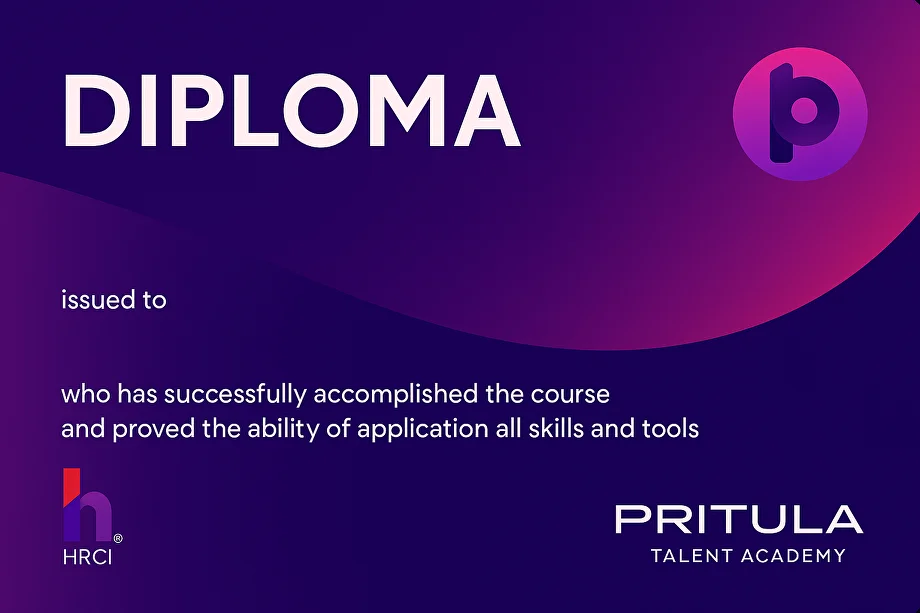
- DiplomaComplete the course assignments and get an Accredible diploma with a unique code.
Learn on your phone
The course fits in your pocket.
- Same login as on desktopVideo, slides and files for every class — in the iPhone and Android app.
- Synced progressStart a class at your desk — finish it on the way home.
- Homework from your phoneOpen the assignment, write your answer, attach a file and submit it for review.
A diploma that shows on LinkedIn.
After the course you receive a diploma in your name on Accredible — the same platform that issues certificates for Google, Udacity and Kaplan University.
- ✓ A unique code on every diploma — impossible to forge
- ✓ The QR code leads to an online version an employer can verify
- ✓ Add it to your LinkedIn profile in one click
- ✓ Available in English

Taught by Udemy’s #1 HR instructor.
The academy is built on Mike’s 21 years of HR practice.
- #1 HR instructor on Udemy — 1.9M enrollments
- PapaHR is free for up to 25 employees
- 21 years in HR: Wargaming, Preply, iDeals, Starlightmedia, Alfa-Bank, PeopleForce
- Certifications PHRi, SHRM-CP, HCI sHRBP; HRCI representative in Eastern Europe
- Two YouTube Silver Play Buttons
What graduates say.

“I’m already applying everything with my young legal team, and I can see the lessons improve not only my own performance as a manager but the whole company’s. My favorite was the class on OKRs and setting team goals.”Roman BaranovskyiDuring the course: Lawyer · now Senior Associate / Head of Gambling Legal Practice, SBSB FinTech Lawyers LinkedIn profile →

“What I liked most is that you can apply it right away: while still studying I introduced several tools at work and saw real results.”Anna YaroshHead of HR, Uzhhorod P.S.Yu. LLC Facebook profile →

“All our managers study the same topics, just at different times, so we speak one language: the language of understanding people and their needs.”Hanna RevenkoCoordinator Clinical Operations, PSI CRO LinkedIn profile →

“In particular, I started spending more time building trust within the team: one-on-one meetings, sharing stories about myself.”Vitalii KachurenkoChief Engineer, TIS-Ruda LinkedIn profile →
Reviews come from the surveys graduates fill in when they receive their diploma.
Frequently asked questions.
What is people management?
People management is a manager’s work with people: hiring and training, setting goals, motivation, feedback, development and checking results. The aim is a group that reaches a shared goal and can work without the manager constantly stepping in.
What does people management include?
Building the team, training and development, 1:1s and coaching, choosing a deputy, motivation, pay and bonuses, retention, strategy and goals, teamwork and oversight. Each topic has its own class in the course.
How is people management different from micromanagement?
Micromanagement means checking every step. In people management, the manager sets goals and provides resources and feedback, and leaves the how to the team.
Which leadership style should I use with an employee?
It depends on their development level: can they do the task, and do they want to? A newcomer needs clear direction, a disillusioned learner needs direction and support, a capable but unwilling performer needs support, and a self-reliant achiever needs delegation. This is the situational leadership model, covered in class 13.
How do you run a 1:1 with an employee?
Use a template: rapport, questions about their work and wellbeing, feedback, agreements and a short report. Class 3 gives you a ready question set, an employee problem checklist and ways to track meetings.
How much does it cost when an employee quits?
By the rule in class 9, from 3 monthly salaries for an entry-level employee to 18 for a manager and 36 for someone irreplaceable. A year of retention costs about 30% on top of their salary, so keeping strong people is usually cheaper than replacing them.
How do you motivate people beyond money?
Class 6 covers Herzberg’s, Maslow’s and Daniel Pink’s models, the difference between motivation, engagement and loyalty, diagnosing demotivation and Neel Doshi’s questionnaire. Money — pay and bonuses — is in classes 7 and 8.
When should a manager start building people management?
When the manager does the team’s work, results drop whenever they’re away, and strong people leave. These are signs that the team depends on one person.
Who is the People Management course for?
New and experienced managers, business owners and HR professionals who support managers: to build a strong team, develop and motivate it, and free up time for strategy.
Is the course included in the subscription?
Yes. The $1,000 annual subscription opens 175+ academy courses, 155+ already in English — including this one, Situational Leadership and Coaching.
How long is the access?
1 year from the day your student account opens. All 13 classes are recorded.
Can I study on my phone?
Yes. Classes open in the iPhone and Android app with the same login as on desktop, and your progress syncs.
Will I get a diploma?
Yes. Complete the course assignments and get a diploma in your name on Accredible, with a unique code and online verification. Available in English.
More courses for managers
Still have questions? Write to us.
Telegram WhatsApp info@pritula.academy Academy student chat on Telegram →