



LMS Choosing, launching and running a learning system A system people actually finish.
Seven lessons: choose an LMS by requirements and scores, not by how good the demo looked, launch it in 30 days, build a course with tests and homework — and see in numbers who reached the end and at which lesson people drop out. All of it on the live screen of Softbook, the LMS the academy itself runs on, and compared with TalentLMS, AcademyOcean, LearnWorlds and Moodle.
- CompanyHR, L&D, training manager · 50–1,000 people
- Schoolonline school owner or expert who sells courses
- Recorded · access right away
- 7 lessons · 45 min
- 7 ready-made tools
- 1 year of access
- Homework reviewed by Mike
- Academy diploma · Accredible
- LMS selection scorecard with weights
- Shortlist of 3 systems
- 30-day launch plan
- Course structure template
- Question bank and homework criteria
- Learner touchpoint map
- Learning metrics dashboard
A company or a school. One job — get people to the certificate.
The course works for two scenarios: training employees at a company and an online school that sells courses. The core is shared, the examples come from both worlds. Where the steps differ, you see both columns: payments and access for a school, groups and mandatory courses for a company.
- 01Company. HR, L&D or training manager at a company of 50–1,000 people
- 02School. Online school owner or expert who sells their own courses
- 03Training already runs — in folders, chats, or an LMS where few people finish
- Run training
- Put materials together
- Work in Google Docs and spreadsheets
- Choose an LMS by requirements, not by how good the demo looked
- Build a course in it with tests and homework
- Set up reminders so that people finish
- Calculate completion and the cost per learner
Training lives in folders and chats, and nobody finishes in the LMS.
- A step-by-step guide to every setting of one system
- Your own LMS and integrations in code
- Promoting and selling courses: funnels, ads, landing pages
Choose. Launch. Build a course — and count.
The course follows the order in which an LMS appears in the life of a company or school: first choosing the system, then working inside it, and finally — getting people to finish and seeing it in numbers.
- Lessons 1–2
Choosing the system
What to require from an LMS and what the market offers. Three systems in the final, each tested on a trial.
Scorecard · Shortlist - Lessons 3–5
Working inside the system
A 30-day launch, building a course from modules and lessons, tests and homework review.
Launch plan · Course template · Question bank - Lessons 6–7
Completion and numbers
Reminders and support along the learner's path, completion, activity and the cost of training.
Touchpoint map · Metrics dashboard
- 01Video · 45 minutesWith the LMS screen shown
- 02A one-action assignmentWith your own company or school
- 03A ready-made toolA template, a spreadsheet or a checklist
Softbook — the LMS where the academy itself teaches.
From lesson 2 to lesson 7 Mike shows how it works in a live system. You study in it yourself and see it through a learner's eyes.
- TalentLMS
- AcademyOcean
- LearnWorlds
- Moodle
The course is not tied to one system: after each demo you see where the same feature lives in others.
- 7lessons · 45 minutes
- 7ready-made tools
- 2scenarios · company and school
- 11+systems in the market review
- 1 yearof access
Compare three systems on your own requirements.
This is a simplified scorecard from lesson 1, filled in with an example from the course. Pick a scenario, type in the three LMSs you are looking at, change the answers on must-have requirements and the scores. Group weights are already set — before the demos, so the winner is not whoever presents best.
1 no · 3 yes, with caveats · 5 fully covers the scenario
- 18requirement groups with vendor examples
- Your ownrequirements and group weights
- 3 yearscost of ownership by pricing model
- 4pilot metrics and tasks
- PDFsaving, CSV and printing
Seven lessons — seven files in your hands.
Every lesson ends with a working tool and a one-action assignment with your own company or school. Open a lesson to see what you will be able to do, what is inside and what you take away.
01Requirements and choosing an LMSScorecard
Write LMS requirements and compare systems by scores, not by how good the demo looked.
- Seven steps to choose an LMS
- Learning scenarios instead of a feature list
- 18 groups of LMS requirements
- Marking must and nice
- A weighted scorecard before the demos
- Cost of ownership over 3 years
- 12 questions for the vendor, and the pilot
LMS selection scorecard: requirements marked must and nice, group weights, scores for three systems, the total, 3-year cost and a pilot plan
- A one-action assignment Write down 10 LMS requirements for your company or school, mark them must or nice and set the weights before the first demo
02The LMS market: a review of systemsShortlist
Pick three systems for your scenario and test them on a trial.
- Four segments of the LMS market
- At least 6 systems for online schools
- At least 5 systems for employee training
- Open-source and large enterprise systems
- Free trial, free plan or demo only
- A test drive of 5 tasks
- A shortlist of three systems
A shortlist of three systems for your scenario — each opened on a trial and checked against the 5 test-drive tasks
- A one-action assignment Sign up for three systems without calling sales, and build one lesson with a test from your own material in each
- Softbook screen how it looks in a live LMS · and in other systems
03Launching an LMS in 30 daysLaunch plan
Set up the structure, roles and groups, invite people and run a pilot.
- Launch plan: 9 stages in 30 days
- Project goal and owner
- Group structure for a company and a school
- Role matrix
- Branding, domain and sender email
- Importing and inviting the pilot group
- Launch communication and rolling out in waves
30-day launch plan: 9 stages by week with owners, a role matrix, a group map, a people import file and a pre-invitation checklist
- A one-action assignment Draw the group map of your company or school and fill in the role matrix: who is admin, who is author, who reviews, who sees progress
- Softbook screen how it looks in a live LMS · and in other systems
04Building a course in an LMSCourse template
Build a course from modules and lessons with scheduled release and a certificate.
- Course structure: course, module, lesson, step
- The lesson card
- Lesson types and the 6-minute rule
- Scheduled release: cohort or self-paced
- Sequential progress and gate lessons
- Access period and certificate
- AI generation of a course outline
Course structure template: modules, lessons with a release mode, gate lessons and a certificate — plus a lesson card
- A one-action assignment Lay out one of your courses in the template: modules with an outcome, lessons with one task, gate lessons and a release mode
- Softbook screen how it looks in a live LMS · and in other systems
05Tests, homework and reviewQuestion bank
Write a test with good answer options and review assignments against criteria.
- Test or homework
- 12 rules of a good question
- Wrong options built from typical mistakes
- Test settings: pass mark, attempts, timer
- A 4-level homework rubric
- Tutor comment templates
- Question statistics and review deadlines
A bank of 10 test questions for your course and a homework rubric: 4 criteria × 4 levels, with tutor comment templates
- A one-action assignment Rewrite 5 questions of your test by the 12 rules: three options, wrong answers from typical mistakes, no «all of the above»
- Softbook screen how it looks in a live LMS · and in other systems
06Completion and engagementTouchpoint map
Build reminders and support points along the learner's path from invitation to certificate.
- Why people don't finish
- 7 points on the learner's path
- The first week decides
- The middle of the course and live contact
- Deadline, completion and after the course
- At least 5 touchpoint channels
- Touchpoint texts for a company and a school
Learner touchpoint map: 7 points on the path — risk, LMS trigger, channel, who writes, text and the stage metric
- A one-action assignment List 7 points on your course's learner path and write one touchpoint for each: trigger, channel and text
- Softbook screen how it looks in a live LMS · and in other systems
07Learning analyticsDashboard
Calculate completion, activity and the cost of training, and find the lesson where people drop out.
- Dashboard: 10 learning metrics
- Completion rate and share of starters
- Funnel by lesson
- Activity and dropout risk
- Time to complete and test quality
- Willingness to recommend (NPS) and course rating
- Cost of training, revenue and lifetime value of a customer (LTV)
Learning metrics dashboard: 10 metrics with a formula, where to find it in the LMS, a benchmark and an action in the red zone — for a company and for a school
- A one-action assignment Open your LMS analytics, calculate completion and find the lesson where you lose the most learners
- Softbook screen how it looks in a live LMS · and in other systems
One course — or the whole academy.
Take this course on its own, or get a year of every course in the academy — for yourself or for your whole team.
- 7 video lessons of 45 minutes, recorded
- Access right after payment
- 7 ready-made tools: scorecard, templates, spreadsheets
- Homework reviewed by Mike
- Academy diploma on Accredible
- 1 year of access
- Includes this course — with all its tools
- 175+ courses of the academy
- New courses every week
- Homework and diplomas in every course
- 1 year of access
- SHRM-SCP and HR MBA are premium, outside the subscription
- 175+ courses for the whole team
- Up to 10 people on one plan
- Homework and diplomas for everyone
- 1 year of access
- 7lessons of 45 minutes with a live LMS screen and comparison with other systems
- 2scenarios in every lesson: training employees at a company and an online school with customers
- 7one-action assignments with your own company or school — reviewed by Mike
- 01LMS selection scorecard: must and nice requirements, group weights, scores for three systems, 3-year cost and a pilot plan
- 02Shortlist of three systems, each tested on a trial against 5 tasks
- 0330-day launch plan: stages by week, role matrix, group map, pre-invitation checklist
- 04Course structure template: modules, lessons, scheduled release, gate lessons and a certificate
- 05Test question bank and a homework rubric with comment templates
- 06Learner touchpoint map: 7 points on the path, LMS trigger, channel and reminder text
- 07Learning metrics dashboard: completion, activity, cost per learner and actions in the red zone
An academy that has taught since 2011.
These are the academy's numbers — students, courses, countries. This course is new, so it has no numbers of its own yet.
Every number can be checked.
- SourcesVendor numbers and quotes come from their websites, each with its source.
- Fresh pricesSystem prices were checked on vendor websites before recording and are shown as «from».
- A live systemThe techniques are shown on the LMS the academy itself works in every day.
Watch, do, get feedback. Watch the academy before you pay.
- 1Watch a lesson · 45 minutes
Recorded, whenever it suits you. Access opens right after payment.
- 2Open the lesson's tool
A page in your browser or an Excel spreadsheet — fill it in for your company or school.
- 3Do a one-action assignment
For example, write down 10 LMS requirements or find the lesson where you lose the most learners.
- 4Mike reviews your assignment
Personally, with a comment on what works and what to fix.
- 5Seven lessons — seven tools
From choosing a system to a learning metrics dashboard.
- 6Get the academy diploma
On Accredible, once you complete the course.
Not sure yet? Watch the academy on YouTube.
The academy's English-language YouTube channel has 100K+ subscribers. Watch it for free and see how the academy teaches before you pay.
A diploma anyone can verify online.
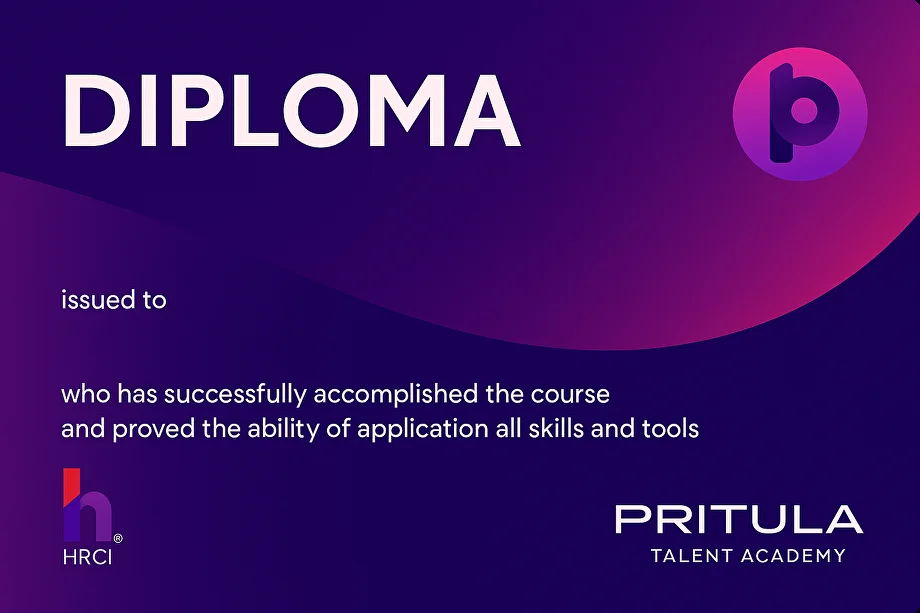
- 01Pritula Academy diploma
You get it once you complete the course.
- 02Issued on Accredible
The same platform Google, Udacity and Kaplan University use for their credentials.
- 03Its own link
Add it to LinkedIn or send it to an employer.

An author who has chosen an LMS more than once.
Mike 20 years in HR and founded Pritula Academy. He has chosen learning systems both at the companies where he worked and for his own academy: he built scorecards, compared package prices and switched systems when it paid off.
- iDeals
Mike built a scorecard, and Matrix LMS won on almost every point except design. The first manager got access to build a course — and a couple of days later refused to work in it.
- Docebo
The package with the features they needed cost $60,000 a year — too expensive for a company of 110 people. The affordable $10,000 package was basic and did not have those features.
- Academy
Mike has chosen a system for the academy several times. Moving to Softbook cut the price roughly in half — with no loss of features.
- Homework review
Learners see Softbook through a learner's eyes, Mike sees it from his side: the whole course and the review of your homework.
- Wargaming
- Preply
- iDeals
- Starlightmedia
- Alfa-Bank (Sense Bank)
- PeopleForce
HRCI representative in Eastern Europe
You will choose your next LMS by the scores.
Seven lessons, seven ready-made tools and assignments with your own company or school — from system requirements to a dashboard that shows who reached the end.
When do I get access?
Right after payment. The course is recorded, and access lasts for one year.
How much time does the course take?
Seven lessons of 45 minutes each. After every lesson there is a one-action assignment with your own company or school and a ready-made tool for it.
Is the course for a company or for an online school?
Both. The core is shared, and where the steps differ — payments and access for a school, groups and mandatory courses for a company — each lesson covers both scenarios.
We already have an LMS. Is the course still useful?
Yes. Lessons 3–7 are about working inside the system: launch, course building, tests and homework review, completion and analytics. The techniques are written to work in any LMS.
Is the course only about Softbook?
No. Softbook is the live screen: the academy runs on this LMS and its students learn in it. Every technique is also shown in other systems: TalentLMS, AcademyOcean, LearnWorlds and Moodle.
Do I need to know how to code?
No. Working in Google Docs and spreadsheets is enough. Building your own LMS and integrations in code are not part of the course.
What format are the course tools in?
Interactive pages that open in your browser, and Excel spreadsheets. You fill them in for your company or school.
Who reviews the homework?
Mike Pritula reviews the assignments personally.
What do I get after the course?
Seven filled-in tools and a Pritula Academy diploma on Accredible — with its own link you can add to LinkedIn.
Is the course included in the academy subscription?
Yes. The $1,000 per year subscription includes this course and 160+ other courses of the academy.
Can I train my whole team?
Yes. The team plan is $2,500 per year for a team of up to 10 people, with access to 175+ courses of the academy.
What is not in the course?
A step-by-step guide to every setting of one system; methods for developing learning content, scripts and video shooting; building your own LMS and integrations in code; promoting and selling online courses; legal matters: contracts, personal data and taxes of an online school.
A question before you start? Write to us.
Ask about the course, payment, the subscription or the team plan in whichever messenger you already use. We answer during working hours.