On-demand course · 20 lessons
Chief Financial Officer (CFO)
Run a company’s money the way boards and investors expect — from cash forecasts to raising capital.
Or 175+ courses — $1,000 a year

Kostyantyn Yerokhin — course author, former CFO of ELEKS and Finance Director at Intellias, PhD in Economics (Candidate of Sciences).
13-week cash forecast$ thousand, end of week1
example- Week 5640580420
- Week 6510690240
- Week 7450740−50
- Week 8820600170
Cash gap in week 74 — line up invoice discounting before it hits3
- 1Cash managementlesson 10
- 2Rolling forecastlesson 7
- 3Raising debtlesson 12
- 4Cash gapslesson 10
Our students work at
























What does a CFO do?
A chief financial officer (CFO) runs a company’s finances: strategy and planning, budgets and forecasts, cash, risk and internal controls, raising capital, and reporting to the CEO, the board, investors and auditors.
The course goes through the full scope of the role in 20 lessons — from the structure of the finance function to M&A, debt and equity financing, an IPO and investor relations.
What the course covers
- The CFO role
- The finance function’s structure; working with the CEO, the board and auditors Lesson 1
- Strategy and risk
- Strategic planning, forecasting, currency and interest-rate risk, internal controls Lessons 2–4
- Performance and deals
- Cash conversion cycle, free cash flow, break-even, return on capital; M&A Lessons 5–6
- Budgets and pricing
- Budgeting and rolling forecasts, pricing models, capital budgeting and NPV Lessons 7–9
- Cash and capital
- Cash management, investments, debt and equity financing, credit ratings Lessons 10–14
- Public markets and IT
- IPO, stock exchanges, investor relations, reporting, stock plans, ERP Lessons 15–20
Twenty lessons — the whole job of a chief financial officer, from the finance team to the stock exchange.
Who the course is for
Finance directors and heads of finance
Step up to the CFO role: capital, investors, M&A and the board, not only budgets and reporting.
Founders and CEOs
Know what to expect from a CFO and how to raise money through debt or equity.
Finance managers and controllers
See the whole finance function — strategy, risk, cash and capital — and where your work fits in it.
Chief accountants
Move from accounting to managing the company’s money and decisions about it.
One more thing — PapaHR
Try the HR platform built by Mike Pritula, the academy’s founder.
Payroll is one of the biggest cost lines a CFO manages. PapaHR keeps the people numbers at hand — the things we cover in the lessons on strategy, controls, performance and budgeting:
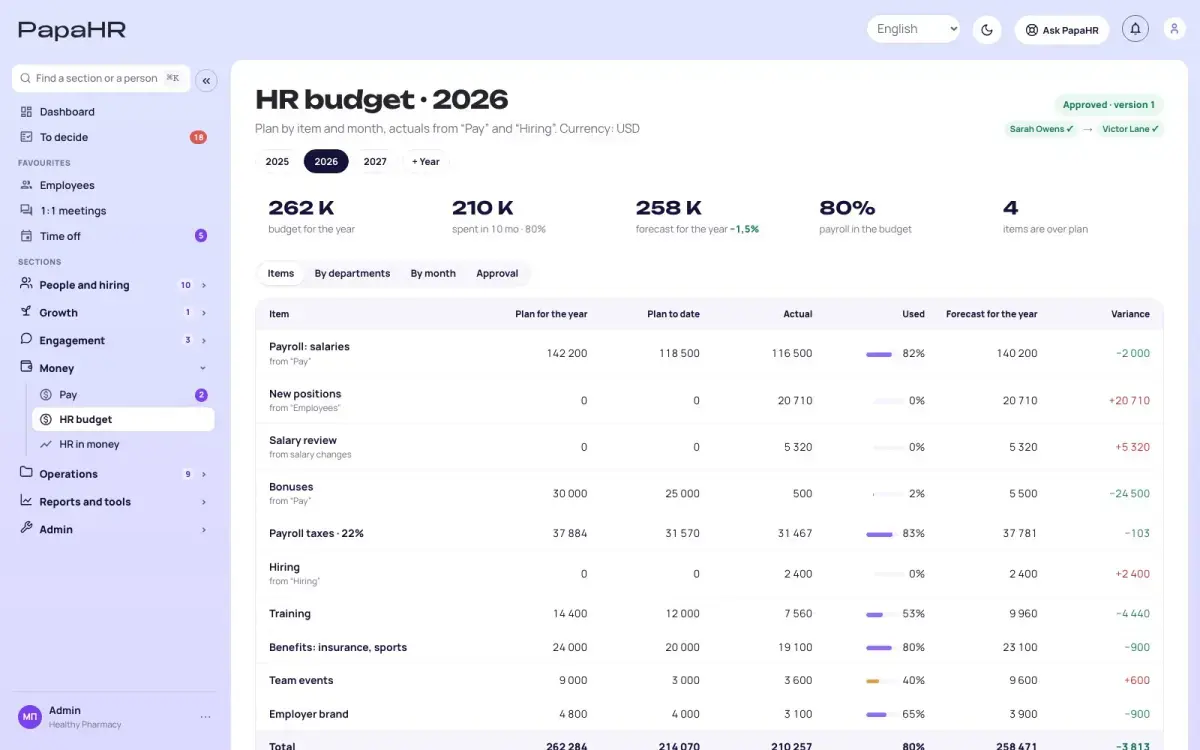
- HR budget by line itemPlan, actuals and a full-year forecast by line item and month — payroll included. The budget is approved right on the platform.Lesson 7
- HR in moneyWhat employee turnover and early leavers cost the company — with ready-to-use text for your CEO.Lesson 5
- OKR goalsCompany and team goals on the same platform as employees, performance reviews and 1:1 meetings.Lesson 2
- HR audit699 questions with hints, then a report with recommendations — an internal check of HR processes.Lesson 4
- Freefor up to 25 employees: employees, time off, surveys, HR audit
- Prowith an academy subscription — up to 50 employees: all sections
- 18ready-made surveys
- 5interface languages
- Telegram · Slack · Teamsplus a mobile app
How much cash is stuck in your working capital?
The cash conversion cycle is one of the performance metrics in Lesson 5: how many days pass between paying suppliers and getting paid by customers. Enter your numbers — the calculator shows the cycle, the cash tied up in it and what ten fewer days of receivables would free up.
Example: a mid-sized company
The default numbers are an example, not course data. Plug in your company’s figures.
Cash conversion cycle
- Cash tied up in working capital
- Receivables
- Inventory minus payables
Cash conversion cycle and free cash flow — Lesson 5; cash forecasting and cash gaps — Lesson 10.
Watch a lesson before you pay.
The full Lesson 1 in English, 66 minutes: what a CFO does every day, accounting and the external rules behind it, compliance, a process model of the finance department, KPIs and management reporting, the board of directors — and a startup case where you build a matrix of financial functions.
You can discuss the course in the academy’s Telegram chat for English-speaking students (request to join).
Join the chat →
20 lessons: from the finance team to the stock exchange.
The course follows the scope of a CFO: the role and the finance function, strategy, risk and controls, performance and M&A, budgets, pricing and investment decisions, then cash, capital, credit ratings, public markets, investor relations, reporting and IT. Every lesson comes with homework and feedback.
01The CFO’s role in the company
- The CFO role in the company
- Organizational structure of the finance function
- Working with the CEO
- Working with the board of directors
- Working with auditors
02Strategic planning
- Strategy overview
- Types of strategies
- Risk analysis
- Strategic focus
- Forecasting
- Acquisition strategy
- Outsourcing
03Risk management
- The CFO’s role in risk management
- Managing currency risk
- Managing interest-rate risk
04The control system
- Fundamentals of accounting control
- The nature of risk
- Principles of control
- Preventive and detective controls
05Performance management
- The cash conversion cycle
- Free cash flow
- Reinvestment metrics
- Break-even point
- Return on capital
06Mergers and acquisitions
- Acquisition strategies
- Why acquisition strategies fail
- Due diligence
- What makes an excellent acquisition target
- Valuing the target company
- Forms of payment
- The legal side of the deal
- Post-acquisition integration
07Budgeting and forecasting
- Pros and cons of budgeting
- Problems with budgeting
- The control and budgeting system
- Goal setting without a budget
- Accounting reports
- Rolling forecast
08Pricing
- Psychological pricing
- Cost-plus pricing
- Dynamic pricing
- The freemium model
- Premium pricing
- Value-based pricing
- Pricing online
- Price elasticity of demand
- Non-price determinants of demand
09Capital budgeting
- The CFO’s responsibility
- Capital budgeting overview
- Bottleneck analysis
- Net present value analysis
- The payback method
10Cash management
- Cash forecasting
- Cash gaps
- Cash concentration
- Notional pooling
11Investment management
- Investment policy guidelines
- Investment strategy
- Repurchase agreements
- Deposits
- Commercial paper
- The money market
- Government debt instruments
- Bonds
- Primary and secondary markets
- Effective interest rate
12Raising funds through debt
- Overview of instruments
- Invoice discounting
- Factoring
- Inventory financing
- Leasing
- Long-term loans
- Alternatives to loans
13Raising funds through equity
- Overview of instruments
- Restricted stock
- Unrestricted stock
- Investors
- Warrants
- Angel investors
- Venture capital
- Crowdfunding
14Credit ratings
- What credit ratings are
- The rating process
15Public and private companies
- Pros and cons of going public
- Initial public offering (IPO)
16Stock exchanges
- New York Stock Exchange
- NASDAQ
- Toronto Stock Exchange
- Delisting
17Investor relations
- The earnings call
- Road show
- Regulation
18Financial reporting of public companies
- Interim reporting
- Earnings per share
- Reporting formats
19Stock management
- Direct stock purchase plan
- Employee stock plan
- Dividend reinvestment plan
- Options
20Information technology
- Types of technology
- Selecting technology
- Using technology based on strategy
- Cloud technology
- ERP systems
- Sales automation
After the course
Your LinkedIn at the level of a chief financial officer.
Your Name
Chief Financial Officer · financial strategy, treasury, capital raising
Experience
- Strategic planning and forecastingLesson 2
- Risk management and internal controlsLessons 3–4
- Budgeting and rolling forecastsLesson 7
- Cash and investment managementLessons 10–11
- Debt and equity financingLessons 12–13
- Investor relations and reportingLessons 17–18
Licenses & certifications
Skills
- Financial Strategy
- Financial Planning & Analysis
- Treasury Management
- Risk Management
- M&A
- Investor Relations
Every line of experience is something you practice in the course. The lesson number is next to it.
What chief financial officers earn in Europe
$10,900a month — average across 6 countries
€118,700 a year
- Germany$13,400
- Netherlands$12,000
- United Kingdom$11,200
- Ireland$10,000
- France$9,900
- Spain$9,200
PayScale, Chief Financial Officer (CFO), November 2026: median base salary without bonuses, before tax; a simple average across 6 countries, samples from 20 to 112 profiles. Converted at the ECB rate of 13 November 2026: €1 = $1.1052, £0.8356. The course does not guarantee a job or a salary.
One course — or the whole academy.
This course
All 20 recorded lessons, homework review and a diploma. 1 year of access.
Get the course →Annual subscription
175+ academy courses, 155+ already in English — including this one, Company Financial Management and Business and Finance for HR. Lessons, homework review and diplomas for every course.
Subscribe →For teams
A subscription to 175+ courses (155+ in English) for a team of up to 10 — for example, your finance team.
Buy for your team →From payment to diploma.
- Lessons at your own paceVideo, slides and materials for every lesson are in your student account, on desktop or phone. 1 year of access.
- Homework with reviewA practical assignment for every lesson, with feedback.
- Questions in the chatYou can discuss the course and your own cases in the academy’s Telegram chat for English-speaking students (request to join).
- DiplomaComplete the course assignments and get an Accredible diploma with a unique code.
Learn on your phone
The course fits in your pocket.
- Same login as on desktopVideo, slides and files for every lesson — in the iPhone and Android app.
- Synced progressStart a lesson at your desk — finish it on the way home.
- Homework from your phoneOpen the assignment, write your answer, attach a file and submit it for review.
A diploma that shows on LinkedIn.
After the course you receive a diploma in your name on Accredible — the same platform that issues certificates for Google, Udacity and Kaplan University.
- ✓ A unique code on every diploma — impossible to forge
- ✓ The QR code leads to an online version an employer can verify
- ✓ Add it to your LinkedIn profile in one click
- ✓ Available in English
Taught by Kostyantyn Yerokhin.
More than 20 years in finance: from chief accountant to finance director of IT companies.
- CFO of ELEKS (2014–2017) and Finance Director at Intellias (2017–2020)
- Built the finance function: strategy, budgeting, controlling, reporting, KPI-based incentives
- PhD in Economics (Candidate of Sciences), associate professor — taught financial management for 16 years
- CIMA CertPM certificate
- Author of 150+ articles and 10 books on accounting, tax and financial management
How the academy teaches.

“The course is very well structured, especially the tables you can use to build a financial system at any company. Of course, at a small company — but as a starting point it is a very good tool where everything is interconnected.”Kateryna KopylNow: Head of Finance Department, BotsCrew Profile on LinkedIn →

“The course is very constructive and easy to follow: afterwards I realized HR needs to look wider, think strategically and analyze every project and situation. … Now I read financial statements with confidence.”Balzhan MyrzabayevaDuring the course: HR consultant ↑ Now: First Deputy CEO, QAZAQ-ASTYQ GROUP Profile on LinkedIn →

“For me, the most important topics were strategic management, the role of HR in running the business, and the organization’s finances. … I liked the case-based teaching — for example, working through the finances of a sample project.”Dariia MelnykDuring the course: HR Manager, Claryfi Now: HR Operations Partner, JustMarkets Profile on LinkedIn →
Reviews come from the surveys graduates fill in when they receive their diploma. The first is about this course; the other two are about the academy’s Business and Finance for HR course.
Frequently asked questions.
What does a CFO do?
A chief financial officer runs the company’s finances: strategy and planning, budgets and forecasts, cash, risk and internal controls, raising capital, and reporting to the CEO, the board, investors and auditors. The role and the structure of the finance function are covered in Lesson 1.
What skills does a CFO need?
Strategic planning and forecasting, risk management and internal controls, budgeting, cash and investment management, financing through debt and equity, M&A, investor relations and reporting — the 20 lessons of the course follow this list.
How do you become a CFO?
Usually from finance director, controller or head of finance roles, by adding the parts of the job beyond reporting: strategy, capital raising, investors and the board. The course covers that scope; it does not guarantee a job or a salary.
How much does a CFO earn in Europe?
According to PayScale (November 2026), the median base salary of a CFO across six European countries averages about $10,900 a month before tax and without bonuses — from about $9,200 in Spain to $13,400 in Germany. The breakdown is above on this page.
What is the cash conversion cycle?
The number of days between paying suppliers and collecting cash from customers: days sales outstanding plus days inventory outstanding minus days payables outstanding. It is one of the performance metrics in Lesson 5; the calculator is above on this page.
How does a CFO manage cash?
With cash forecasts, by spotting cash gaps in advance and by concentrating and pooling cash across accounts. Cash management is Lesson 10; investing spare cash is Lesson 11.
How do companies raise capital?
Through debt — loans, leasing, factoring, invoice discounting — or through equity: angel investors, venture capital, crowdfunding and, for larger companies, an IPO. These are Lessons 12, 13 and 15.
Who is the course for?
Finance directors and heads of finance, finance managers and controllers, chief accountants, founders and CEOs — anyone who works on or with a company’s finances at the top level.
Can I take the course online?
Yes. All 20 lessons are on demand, each with homework and feedback. After the course you get a diploma in your name on Accredible that can be verified online.
Is the course included in the subscription?
Yes. The $1,000 annual subscription opens 175+ academy courses, 155+ already in English — including this one, Company Financial Management and Business and Finance for HR.
How long do I have access?
1 year from the moment your account is opened.
Will I get a diploma?
Yes. Complete the course assignments and get a diploma in your name on Accredible with a unique code and online verification.
More courses on finance and business
Still have questions? Write to us.
Telegram WhatsApp info@pritula.academy Telegram chat for English-speaking students (request to join) →